





Top 10 Wati Alternatives for WhatsApp Marketing in 2026: Smarter Tools for Shopify and E-Commerce Brands

Top 10 Wati Alternatives for WhatsApp Marketing in 2026: Smarter Tools for Shopify and E-Commerce Brands
Your email campaigns are going unread. Your SMS blasts barely get any traction. And yet, your customers are on WhatsApp, checking it 23 to 25 times a day. WhatsApp messages carry an average open rate of 98%, compared to just 20% for email.
But adopting a WhatsApp channel does not automatically mean the tool you use is the right fit. For Shopify merchants, basic messaging is rarely enough. You also need cart recovery, order updates, COD verification, customer support, and automation that fits into your store workflow.
That is why many businesses start looking for alternatives to WATI. As teams grow, they often need stronger Shopify integration, better automation, and more flexibility across sales, support, and marketing use cases.
This guide covers 10 WATI alternatives for 2026, with a closer look at the tools that offer better support for Shopify and growing e-commerce brands.
Key Takeaways
- Zoko, DelightChat, Gallabox, and Interakt are the stronger picks for Shopify and e-commerce teams, with Zoko offering the deepest fit for WhatsApp-led revenue, catalog sync, cart recovery, COD workflows, and ROI tracking.
- Respond.io, Trengo, Brevo, Helpwise, and Bird are better suited to businesses that need multi-channel communication across WhatsApp, email, Instagram, Facebook, SMS, or voice, rather than a WhatsApp-only setup.
- For broadcast-led marketing and scale, AiSensy and Bird stand out, while Interakt and Brevo offer more budget-friendly options for teams that want lower-cost entry points.
- For support and collaboration, DelightChat, Helpwise, Trengo, and Respond.io are strong choices, though their value differs based on whether you need Shopify context, omnichannel support, or simpler inbox workflows.
Why Shopify Merchants Outgrow WATI: Key Limitations and Better Alternatives
WATI (WhatsApp Team Inbox) is a WhatsApp Business Solution Provider (BSP) built on the official WhatsApp Business API. It lets businesses connect a WhatsApp number to a shared team inbox, build basic chatbot flows, and send broadcast messages to opted-in contacts.
Where WATI works well:
- Small teams that only need WhatsApp for customer support
- Businesses looking for a low-setup, out-of-the-box shared inbox
- Brands that want basic chatbot automation without deep technical configuration
- Teams that do not yet need Shopify-native integrations or catalog selling
Where teams start outgrowing WATI:
- WATI only works with WhatsApp. If your customers also contact you via Instagram DMs, email, or Facebook Messenger, you will still need a separate tool.
- The default chatbot responds only to keywords; it cannot hold a contextual conversation. The more capable flow builder costs an additional $149/month on top of the base plan.
- There is no native Shopify catalog sync. You cannot sell products directly inside a WhatsApp conversation through WATI.
- Analytics are limited. Tracking revenue influenced by a campaign, or identifying which broadcast drove actual orders, is not straightforward.
- Pricing starts at $69/month for just five agents, with no free trial, and costs scale quickly as you add more seats or features.
10 Better and Affordable Wati Alternatives for WhatsApp Marketing in 2026
If WATI no longer fits your budget, workflow, or growth needs, this list will help you compare stronger alternatives for 2026. The table below gives you a quick snapshot of the top options, while the detailed breakdowns explain each platform’s strengths, limitations, and best-fit use cases.
| Tool | Shopify/G2 Rating | Automation Depth | Best For |
|---|---|---|---|
| Zoko | Shopify: 4.8/5 |
Advanced flows | Shopify merchants, D2C revenue growth |
| Interakt | Shopify: 3.9/5 |
Standard | SMBs on a budget |
| Respond.io | G2: 4.8/5 | Enterprise-grade | Multi-channel sales teams |
| Gallabox | Shopify: 4.0/5 |
Strong templates | D2C e-commerce, South Asia |
| AiSensy | Shopify: 1.6/5 |
Broadcast-focused | High-volume broadcast campaigns |
| Trengo | G2: 4.3/5 | Rule-based | European multi-channel teams |
| DelightChat | Shopify: 4.8/5 | E-commerce flows | Shopify support-first brands |
| Brevo | Shopify: 4.8/5 | Multi-channel | Email/SMS teams adding WhatsApp |
| Helpwise | Shopify: 4.5/5 | Basic rules | Small teams, simple inbox needs |
| Bird | G2: 3.6/5 | Enterprise API | High-volume enterprise messaging |
1. Zoko: Best for Shopify Merchants Who Want WhatsApp as a Revenue Channel
If you run a Shopify store and your goal is to turn WhatsApp into a direct revenue driver, then Zoko deserves the top spot on this list. Built from the ground up for Shopify merchants, Zoko combines WhatsApp Business API access, sales automation, and a full-featured shared inbox in a single platform.
Unlike WATI, which often requires expensive add-ons for advanced features, Zoko is built specifically for Shopify merchants, offering native Shopify catalog sync, advanced sales automation workflows, and seamless multi-agent collaboration without the hefty price tag.
Key Features
- WhatsApp catalog sync directly from your Shopify store
- Broadcast campaigns with audience segmentation by purchase behavior
- Advanced visual flow builder for COD confirmation, cart recovery, upsells, and re-engagement
- Shared team inbox with assignment rules for support agents
- Official Meta Business Partner, full API access, and green tick eligibility
- Automated order notifications, delivery updates, and review requests
- Built-in ROI analytics to track revenue driven by WhatsApp
Pricing: Starts from $49.99/month
Pros and Cons
| Pros | Cons |
|---|---|
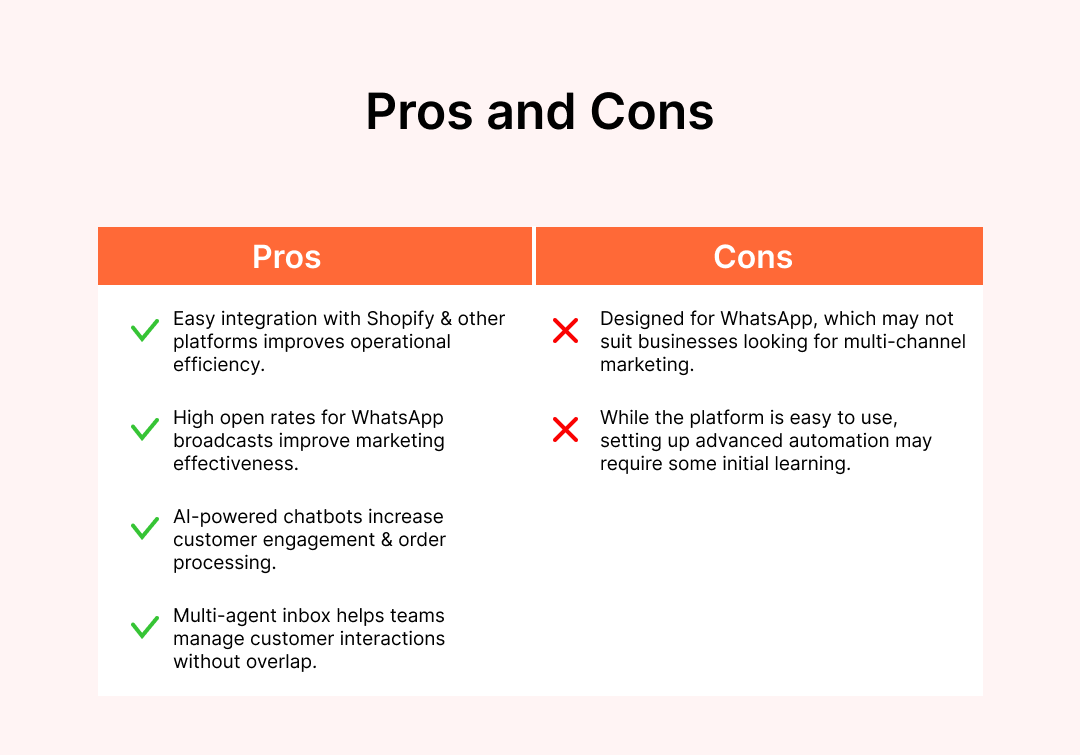
| Easy integration with Shopify and other platforms improves operational efficiency. | Designed for WhatsApp, which may not suit businesses looking for multi-channel marketing. |
| High open rates for WhatsApp broadcasts improve marketing effectiveness. | While the platform is easy to use, setting up advanced automation may require some initial learning. |
| AI-powered chatbots increase customer engagement and order processing. | - |
| Multi-agent inbox helps teams manage customer interactions without overlap. | - |
For Shopify merchants who want WhatsApp to do more than handle queries, Zoko offers a stronger path to revenue, retention, and smoother customer journeys. Start your 7-day free trial today!
2. Interakt: Best for SMBs Needing an All-in-One WhatsApp CRM
Interakt is one of the more established WhatsApp Business API providers in the Indian market and has quickly expanded its presence across Southeast Asia and the Middle East. It offers a solid combination of a shared team inbox, campaign manager, and a growing catalog of automation workflows.
Key Features
- Shared WhatsApp inbox for team collaboration
- WhatsApp broadcast campaigns with audience filters
- Shopify and WooCommerce integration for order notifications
- No-code chatbot builder for basic FAQ automation
- User activity tracking and engagement analytics
- Competitive pricing with affordable entry-level plans
Pricing: Starts from $15/month
Pros and Cons
| Pros | Cons |
|---|---|
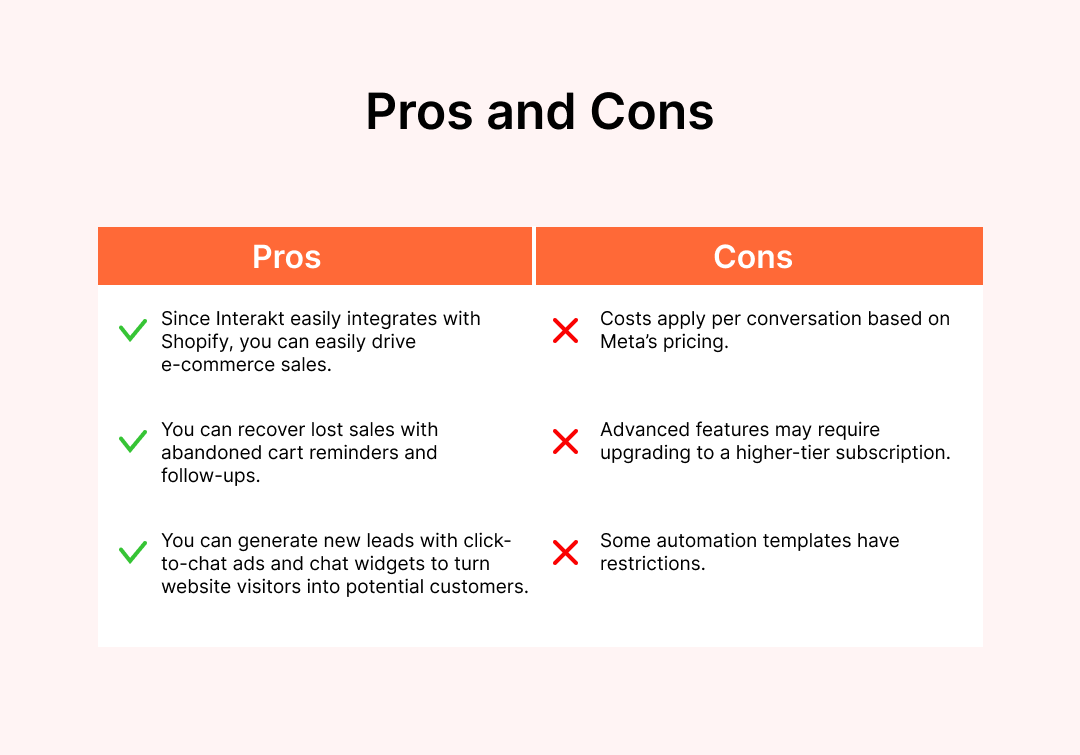
| Since Interakt easily integrates with Shopify, you can easily drive e-commerce sales. | Costs apply per conversation based on Meta’s pricing. |
| Pros | Cons |
|---|---|
| Since Interakt easily integrates with Shopify, you can easily drive e-commerce sales. | Costs apply per conversation based on Meta’s pricing. |
| You can recover lost sales with abandoned cart reminders and follow-ups. | Advanced features may require upgrading to a higher-tier subscription. |
| You can generate new leads with click-to-chat ads and chat widgets to turn website visitors into potential customers. | Some automation templates have restrictions. |
3. Respond.io: Best for Omnichannel Sales Teams
Respond.io positions itself as a business messaging OS, a centralized hub for managing customer conversations across WhatsApp, Instagram, Facebook Messenger, Line, Telegram, and more. If your business operates across multiple chat channels and needs a single hub for your sales and support teams, Respond.io is one of the most capable platforms available.
Key Features
- True omnichannel inbox, WhatsApp, Instagram, Facebook, Telegram, Line, and more
- AI-powered conversation routing and assignment
- Workflow automation builder with CRM integrations (HubSpot, Salesforce, Pipedrive)
- WhatsApp broadcast and drip campaigns
- Contact lifecycle tracking and reporting dashboards
- Open API for custom integrations
Pricing: Starts from $79/month
Also Read: The Power of Omni-Channel E-commerce: Leveraging WhatsApp Marketing for Your Shopify Store
Pros and Cons

| Pros | Cons |
|---|---|
| True omnichannel coverage like WhatsApp, TikTok, and Instagram in one platform | Price is steeper than most alternatives, especially for small teams |
| Published 99.999% uptime SLA makes it among the most reliable platforms on this list | Not purpose-built for Shopify, e-commerce flows like catalog sync and COD confirmation require custom setup |
| AI agents learn from your entire knowledge base and handle complex conversations |
4. Gallabox: Best for Automation-First E-Commerce Teams
Gallabox has built a strong reputation in the D2C and e-commerce space with a user-friendly interface and a strong automation engine. It integrates natively with Shopify, WooCommerce, and Razorpay, making it a good fit for merchants in Southeast Asian markets.
Key Features
- Visual flow builder with pre-built e-commerce templates
- Shopify and WooCommerce integrations for order updates and cart recovery
- WhatsApp broadcast campaigns with behavioral segmentation
- Shared team inbox with internal notes and collision detection
- WhatsApp chatbot with AI-powered responses
- Razorpay payment integration for in-chat checkouts
Pricing: Starts from $40/month
Pros and Cons

| Pros | Cons |
|---|---|
| No-code automation makes WhatsApp marketing easy. | Limited advanced AI chatbot features. |
| Affordable solution for small and mid-sized businesses. | Analytics and reporting tools need improvement. |
| Easy integration with Shopify and other CRMs. | Not as customizable for complex workflows. |
5. AiSensy: Best for High-Volume Broadcast Campaigns
AiSensy is a WhatsApp engagement platform built on the official WhatsApp Business API that has seen massive adoption in India. Its core strength is bulk WhatsApp broadcasting, making it a go-to for brands that run frequent promotional campaigns to large subscriber lists.
Key Features
- High-volume WhatsApp broadcast with audience segmentation
- Live chat panel for agent-assisted support
- Chatbot builder for automated FAQs and lead capture
- Campaign analytics with delivery, open, and click tracking
- Shopify integration for order notifications
- Competitive per-conversation pricing model
Pricing: Starts from $19/month
Also Read: AiSensy vs WATI: Comprehensive 2025 Comparison
Pros and Cons
| Pros | Cons |
|---|---|
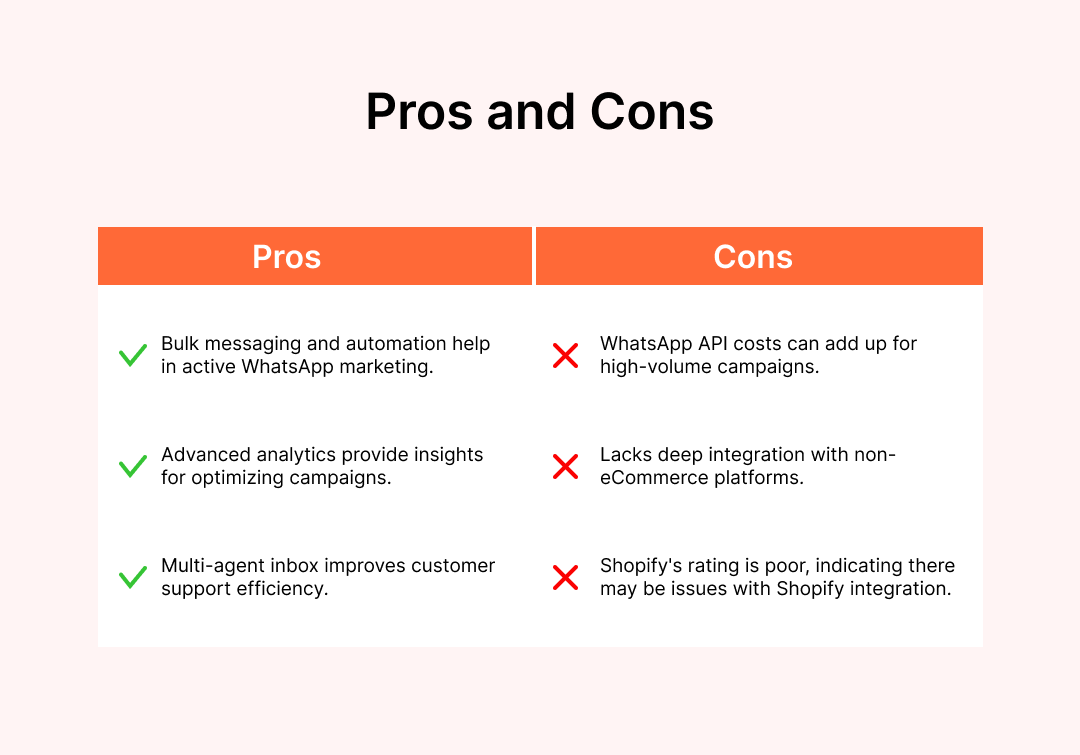
| Bulk messaging and automation help in active WhatsApp marketing. | WhatsApp API costs can add up for high-volume campaigns. |
| Advanced analytics provide insights for optimizing campaigns. | Lacks deep integration with non-eCommerce platforms. |
| Multi-agent inbox improves customer support efficiency. | Shopify's rating is poor, indicating there may be issues with Shopify integration. |
6. Trengo: Best for European Businesses Needing Multi-Channel Support
Trengo is a well-established helpdesk platform based in the Netherlands, popular with European SMBs and mid-market companies. It combines email, WhatsApp, Instagram, Facebook Messenger, live chat, and voice calls into a single team inbox, making it a strong omnichannel option for businesses that need GDPR-compliant tooling.
Key Features
- Omnichannel inbox: WhatsApp, email, Instagram, Facebook, SMS, voice
- Team collaboration tools with internal notes and @mentions
- Rule-based automation for conversation routing
- Help center knowledge base for self-service support
- Integrations with Shopify, Magento, WooCommerce, and major CRMs
- GDPR-compliant infrastructure based in the EU
Pricing: $15 per agent
Pros and Cons

| Pros | Cons |
|---|---|
| Clean, accessible UI with minimal learning curve | Expensive for smaller teams |
| GDPR-compliant EU infrastructure, essential for European businesses handling customer data | WhatsApp broadcast is a paid add-on, not included in the core plan. |
| Centralizes WhatsApp, email, Instagram, Facebook, and SMS in one genuinely unified inbox | Chatbot automation is basic and rule-driven, with no sophisticated AI-native conversation handling |
7. DelightChat: Best for Shopify Brands Focused on Customer Support
DelightChat is a Shopify-first customer support platform that combines WhatsApp, Instagram, Facebook, email, and live chat into a single inbox. It is specifically built for e-commerce brands, offering one-click access to Shopify order data while handling customer queries, no tab-switching required.
Key Features
- Omnichannel inbox with Shopify order context built in
- WhatsApp marketing broadcasts using the official API
- Automated WhatsApp messages for abandoned carts, order confirmations, and delivery updates
- COD verification workflows
- Green tick application support
- Team collaboration with internal notes and assignment rules
Pricing: Starts from $49/month
Pros and Cons

| Pros | Cons |
|---|---|
| Run marketing campaigns effortlessly with features like reorder and winback messages through automated marketing campaigns. | Businesses may require time to optimize AI-driven automations and segmentation. |
| Uses AI to craft catchy marketing messages. | More advanced marketing automation features require higher-tier plans. |
| You can engage customers through WhatsApp broadcasts, upselling, and personalized promotions. | Integration with existing marketing methods and other systems can be challenging. |
8. Brevo (formerly Sendinblue) — Best for Multi-Channel Marketing Automation
Brevo is a full-stack digital marketing platform that added WhatsApp as a native channel to its already suite of email, SMS, and push notification tools. For e-commerce teams already running multi-channel campaigns, Brevo offers the convenience of managing everything — including WhatsApp — from a single marketing platform.
Key Features
- WhatsApp campaign management alongside email, SMS, and push
- Contact list segmentation and advanced marketing automation
- WhatsApp message templates with approval workflow
- Detailed campaign analytics across all channels
- CRM and pipeline management are built in
- Free plan available with limited WhatsApp sends
Pricing: $499 for Enterprise
Pros and Cons
| Pros | Cons |
|---|---|
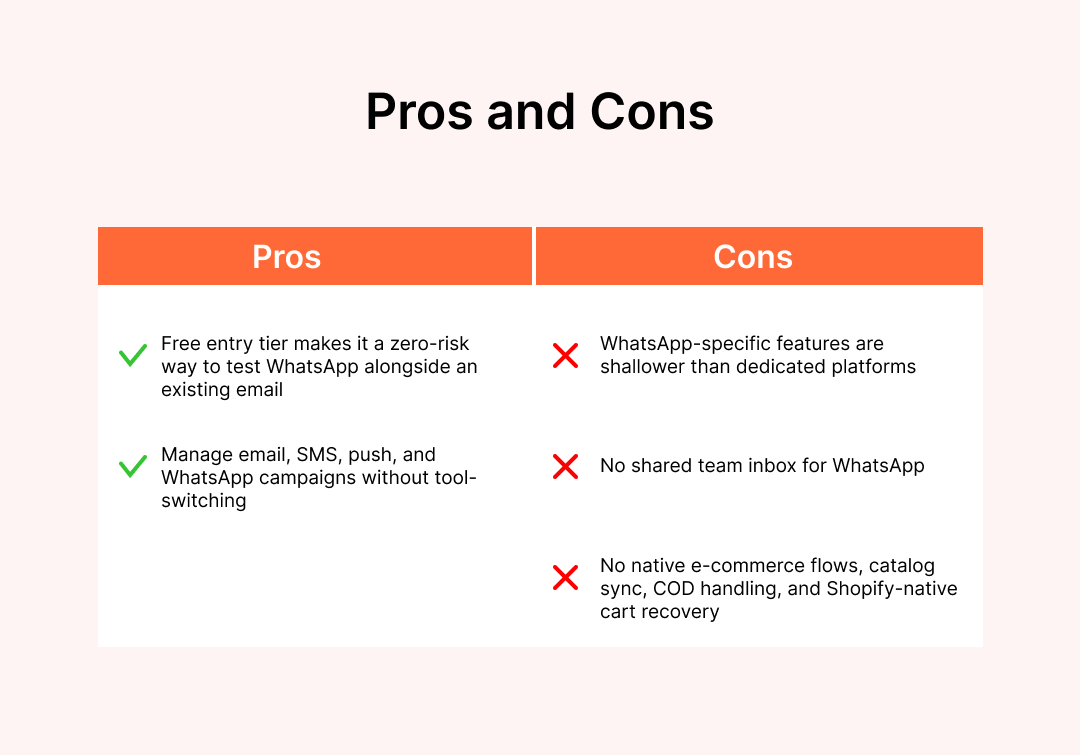
| Free entry tier makes it a zero-risk way to test WhatsApp alongside an existing email | WhatsApp-specific features are shallower than dedicated platforms |
| Manage email, SMS, push, and WhatsApp campaigns without tool-switching | No shared team inbox for WhatsApp |
| No native e-commerce flows, catalog sync, COD handling, and Shopify-native cart recovery |
9. Helpwise: Best for Teams Needing a Simple Shared Inbox
Helpwise is a straightforward shared inbox platform that connects WhatsApp, email, SMS, Facebook Messenger, and Twitter (X) into one dashboard. It is a great entry-level option for small support teams that don't need complex automation but want to stop managing conversations from a single phone.
Key Features
- Shared inbox for WhatsApp, email, SMS, and social media
- Team collaboration with collision detection (see who's replying)
- Automation rules for message routing and tagging
- Shopify, Zapier, HubSpot, and Slack integrations
- Performance metrics and team analytics dashboard
- 7-day free trial with no credit card required
Pricing: Starts from $20/user
Pros and Cons
| Pros | Cons |
|---|---|
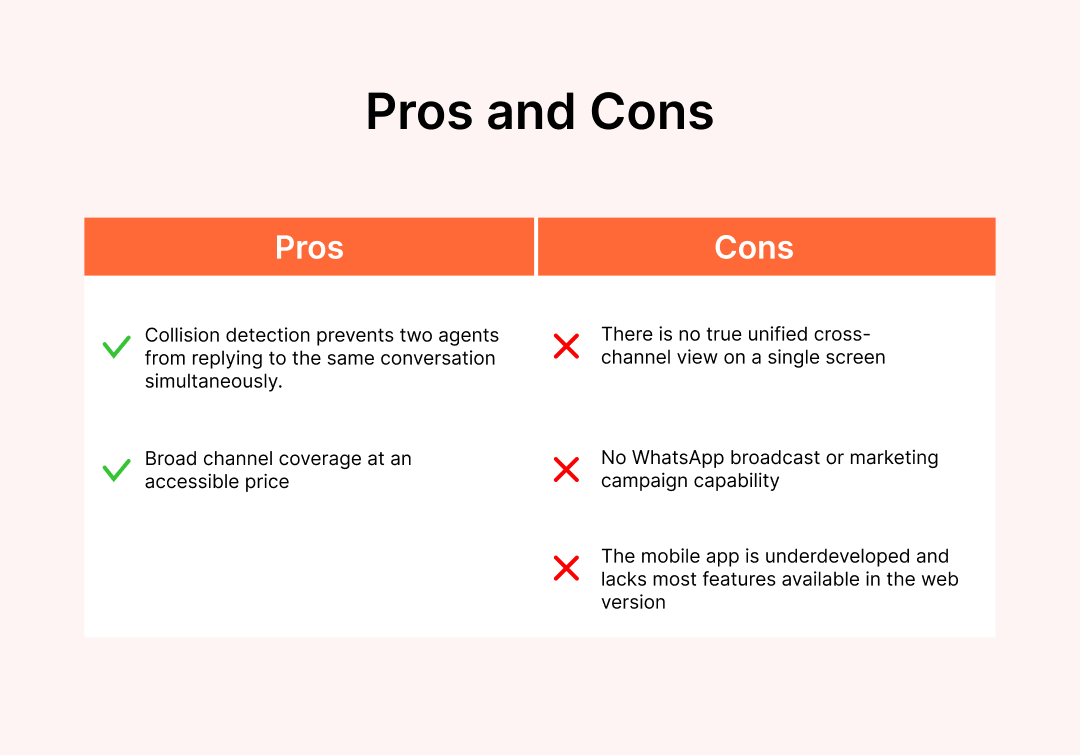
| Collision detection prevents two agents from replying to the same conversation simultaneously. | There is no true unified cross-channel view on a single screen |
| Broad channel coverage at an accessible price | No WhatsApp broadcast or marketing campaign capability |
| The mobile app is underdeveloped and lacks most features available in the web version |
10. Bird (formerly MessageBird) — Best for Enterprise-Scale Omnichannel Messaging
Bird, rebranded from MessageBird, is an enterprise-grade customer communications platform supporting WhatsApp, SMS, email, push, and voice. It is designed for businesses handling very high volumes of outbound and inbound messaging and offers a robust API for custom integrations. If WATI feels too small for where your business is going, Bird is built to scale with you.
Key Features
- WhatsApp Business API with enterprise-grade deliverability
- Omnichannel messaging: WhatsApp, SMS, email, push, voice
- Drag-and-drop journey builder for multi-channel automation
- Advanced segmentation and personalization for broadcast campaigns
- Developer-friendly API with comprehensive documentation
- Pay-as-you-go pricing, no seat-based subscription
Pricing: Starts from $45 for Pro plan
Pros and Cons
| Pros | Cons |
|---|---|
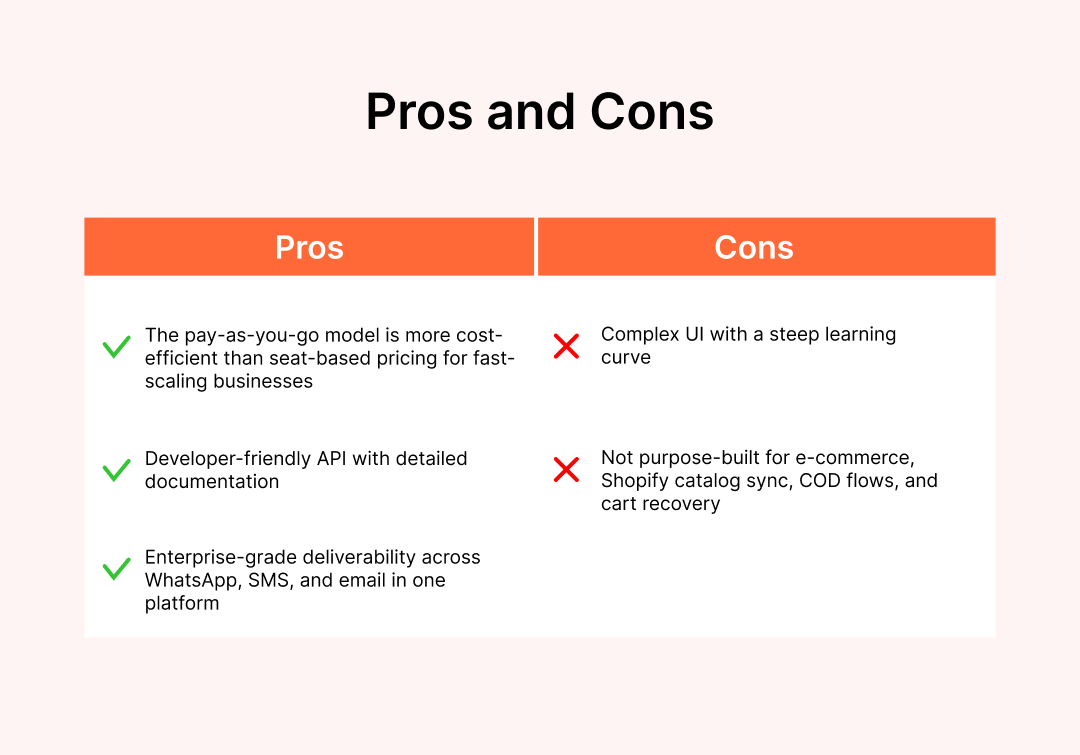
| The pay-as-you-go model is more cost-efficient than seat-based pricing for fast-scaling businesses | Complex UI with a steep learning curve |
| Developer-friendly API with detailed documentation | Not purpose-built for e-commerce, Shopify catalog sync, COD flows, and cart recovery |
| Enterprise-grade deliverability across WhatsApp, SMS, and email in one platform |
Also read: Best Verloop Alternatives for WhatsApp 2025
How to Choose the Right WATI Alternative for Your Business
No single platform is the right answer for every business. Here is how to narrow it down:
- If you are a Shopify merchant: Prioritize platforms with native Shopify integrations. You want a tool that can read your orders, trigger automations based on purchase events, and sync your product catalog. Zoko and DelightChat are the strongest contenders here, with Gallabox also being a solid option.
- If you are a multi-channel brand, look for a true omnichannel inbox. Respond.io and Trengo give you WhatsApp, Instagram, Facebook, and email in one place, important if your customers contact you across multiple platforms.
- If you are running high-volume broadcast campaigns, AiSensy and Bird are optimized for scale. Both handle large subscriber bases with segmentation and detailed campaign analytics.
- If budget is your primary constraint, Interakt and Brevo offer some of the most competitive pricing in the market. Brevo has a free entry-level plan if you are just adding WhatsApp to an existing marketing stack.
Also Read: WATI - Not fit for e-commerce
Conclusion
WATI is not a bad platform; it is just not built for every use case. If you are a growing Shopify merchant, an e-commerce marketing manager chasing abandoned cart recoveries, or a delivery manager who needs real-time COD confirmations, you need a platform that speaks your language.
The platforms listed here range from enterprise-grade omnichannel solutions to razor-focused Shopify revenue tools. The right choice comes down to one question: what does your business actually need WhatsApp to do?
If your business only needs basic WhatsApp messaging, there are plenty of tools, but if you run a Shopify store and want WhatsApp to support sales, cart recovery, COD workflows, customer support, and repeat purchases, you need a platform built for that job.
Zoko is the strongest WATI alternative for Shopify merchants who want WhatsApp to drive revenue, not just conversations. Start your free 7-day trial at Zoko, and see how Zoko helps you sell, support, and automate in one place
Also read: Top WhatsApp Newsletter Software for 2025: A Complete Guide
Also read: Top 10 Instagram Automation Tools to Boost Social Media in 2026
FAQs
1. What is better than WATI?
The better option depends on what your business needs. If you want deeper Shopify integration, stronger automation, and revenue-focused WhatsApp workflows, tools like Zoko may offer a better fit than WATI.
2. Which is best, WATI or Interakt?
WATI may work for teams that need a basic shared inbox and simple automation. Interakt can be a better choice for SMBs that want a more affordable WhatsApp CRM with e-commerce-friendly features.
3. Is WATI an API?
WATI is not the API itself. It is a platform built on the official WhatsApp Business API that helps businesses manage chats, broadcasts, and automation without building everything from scratch.
4. Is WATI a CRM tool?
WATI includes some CRM-like features, such as contact management and shared inbox functions, but it is not a full CRM in the traditional sense. It works more as a WhatsApp communication and automation platform.
5. Can I integrate my existing CRM with WhatsApp marketing platforms?
Yes, many WhatsApp marketing platforms support CRM integrations. The depth of that integration varies, so it is worth checking whether the platform connects with your current tools and supports your workflows.
6. What features should I prioritize when choosing a WhatsApp marketing platform?
Look for features that match your business model, such as automation, broadcast campaigns, shared inboxes, analytics, and e-commerce or CRM integrations. If you sell online, Shopify sync, cart recovery, and order updates should also be high on your list.
Interested to know more?

Case Studies















Featured Posts


Continue reading

The E-Commerce Divide: How the Top 10% of Brands Use AI to Grow 5X Faster (And Why It’s Not for Everyone)
Drive Sales with WhatsApp Catalog Integration: Here's How