



How to Start a Shopify Wholesale Business in 2026: Step-by-Step Guide

How to Start a Shopify Wholesale Business in 2026: Step-by-Step Guide
You have built a successful Shopify store, and demand is growing. Soon, retailers begin asking for bulk pricing and repeat orders. The opportunity to start a Shopify wholesale channel is clear, but most stores are not designed for it. Wholesale orders end up handled through manual quotes, scattered emails, and discount codes that create pricing mistakes and operational confusion.
Many merchants treat wholesale as a quick add-on instead of building a structured B2B system. The result is slow communication, missed reorder opportunities, and frustrated buyers who expect faster responses.
Meanwhile, the opportunity continues to grow. The global B2B e-commerce market is projected to reach USD 155.98 trillion by 2033, according to Grand View Research.
This guide explains how to start a Shopify wholesale business in 2026, covering store setup, pricing structures, buyer acquisition, and the communication tools that help you manage wholesale relationships at scale.
Key Takeaways
- Shopify wholesale focuses on bulk orders, discounted pricing, higher order values, and long-term retailer relationships rather than one-time consumer purchases.
- Merchants should first establish the legal structure, reseller permits, and supplier partnerships before taking bulk orders.
- Your Shopify setup determines how efficiently you run B2B sales. Businesses can manage wholesale using Shopify Plus B2B features, third-party wholesale apps, or a separate storefront based on scale.
- Pricing strategy directly impacts profitability. Sustainable wholesale operations rely on keystone pricing, tiered discounts, minimum order quantities, and MAP policies.
- Scaling wholesale requires structured acquisition and operations. Successful merchants focus on B2B buyer outreach, inventory planning, and KPIs like repeat order rate and average order value.
What Is Shopify Wholesale?
Shopify wholesale is a B2B selling model where you sell products in bulk, to retailers, resellers, or distributors, at discounted prices, directly through your Shopify store. Unlike direct-to-consumer (D2C) retail, wholesale involves higher order volumes, tiered pricing structures, minimum order quantities (MOQs), and flexible payment terms like Net 30 or Net 60.
Wholesale vs. Retail: Key Differences
Before launching a Shopify wholesale channel, it helps to understand how wholesale operations differ from traditional retail sales. Wholesale focuses on selling products in bulk to business buyers, which changes pricing structures, order volumes, and the way relationships are managed.
| Factor | Wholesale (B2B) | Retail (B2C) |
|---|---|---|
| Buyer | Businesses (retailers, resellers, distributors) | Individual consumers |
| Order Size | Bulk (cases, pallets) | Single units or small quantities |
| Price Per Unit | Discounted — 40–60% below retail | Full retail price |
| Payment Terms | Net 30 / Net 60 common | Immediate payment |
| Relationship | Long-term, account-based | Transactional, often one-time |
| Customer Count | Fewer, higher-value accounts | Larger pool, lower AOV |
| Marketing | Relationship-driven, trade-focused | Ads, SEO, social media |
| Avg. Order Value | High ($200–$5,000+) | Low to medium ($30–$200) |
Also Read: Top 10 Best Shopify Apps for Wholesale Pricing
Also read: How to Start a Shopify Store in India: The Step-by-Step Guide (2026)
Step-by-Step Guide to Starting a Shopify Wholesale Business
Launching a Shopify wholesale operation requires more than simply offering bulk discounts. You need the right legal structure, supplier network, store configuration, pricing model, and buyer acquisition strategy to make the channel sustainable.
Step 1: Handle the Legal Groundwork First
This is the step most wholesale guides skip entirely — and it's the one that causes the most avoidable problems. Before you take a single wholesale order, get your legal foundation in place.
- Register Your Business Entity: Choose a formal business structure before your first wholesale transaction. Your three main options are Sole Proprietorship, LLC (Limited Liability Company), and S-Corp or C-Corp.
- Get Your EIN (Employer Identification Number): An EIN is your business's federal tax ID, essential for opening a business bank account, filing taxes, and meeting supplier requirements.
- Obtain a Reseller License / Seller's Permit: If you plan to purchase inventory and resell it wholesale, most states require a reseller certificate (also called a resale license or seller's permit). This allows you to buy goods tax-free since the sales tax obligation shifts to the end buyer.
Step 2: Choose Your Niche and Find Reliable Suppliers
Picking the Right Wholesale Niche
Your niche determines your pricing power, supplier relationships, and the types of retailers you'll attract. The best wholesale niches share three traits: consistent B2B demand, healthy margins, and strong reorder frequency.
The highest-performing wholesale categories for Shopify merchants in 2026 are Health & Wellness, Fashion, Home Decor, Personal Care, Food & Beverage, and Tech Accessories.
Finding and Vetting Suppliers
If you're sourcing from third parties, your supplier decisions are among the most consequential you'll make in wholesale. You can find qualified wholesale suppliers from Alibaba, Global Sources, IndiaMART, and ThomasNet, and Direct outreach to niche manufacturers via LinkedIn and trade directories
Step 3: Set Up Your Shopify Wholesale Store
Shopify gives you multiple approaches to running wholesale, each suited to different budgets and business scales. Choose the right one and build toward the next level as you grow.
Option 1: Shopify Plus — Native B2B Features
Shopify Plus includes purpose-built B2B functionality natively integrated into your admin. Key features include:
- Company profiles with multiple contacts and locations per account
- Customer-specific price lists and catalogs
- Net 30 / Net 60 payment terms are built directly into checkout
- Tax exemption management for B2B buyers
- Multi-currency support for international wholesale
- B2B checkout with PO numbers, saved payment details, and deposit collection
Best for: merchants processing $500K+ annually in wholesale revenue. At that volume, the ROI on Plus is straightforward.
Option 2: Third-Party Wholesale Apps (All Shopify Plans)
You don't need Shopify Plus to run a fully functional wholesale store. Third-party apps on the Shopify App Store deliver most of what Plus offers at a fraction of the cost:
- Wholesale Pricing Discount B2B (Wholesale Helper): Tiered pricing, volume discounts, MOQs, net terms, multi-currency. Best for hybrid B2B/B2C stores.
- B2B Wholesale Hub: Customer tagging, custom pricing, quick order form, net terms, product locking. 4.8/5 with 676+ reviews.
- BSS B2B & Wholesale Solution: All-in-one suite: custom pricing, bulk discounts, approval workflows, MOQ enforcement. 900+ reviews.
Option 3: A Separate Wholesale Storefront
Some merchants prefer a completely separate Shopify store for wholesale, a clean operational split between retail and B2B. This gives you maximum control over the buyer experience but doubles your store management overhead.
Also Read: Revolutionizing Wholesale Trade: Unraveling Zoko's B2B Integration and Pricing Mastery
Step 4: Build a Wholesale Pricing Strategy That Protects Your Margins
Wholesale pricing is the most consequential decision in your entire setup. Price too low and you're funding your buyers' businesses with your own margins. Price too high, and serious buyers walk.
- The Core Pricing Formula: Your wholesale price should allow retailers to apply a standard 100% markup (keystone pricing) and still be competitive at retail. If your unit cost is $8, a wholesale price of $16–$20 gives retailers room to price at $32–$40, a healthy margin on both sides.
- Tiered Pricing: Rewarding Larger Orders: Volume-based tiered pricing is the single most effective lever for growing your average wholesale order value.
- 1–11 units: Standard wholesale price
- 12–23 units: 5% additional discount
- 24–47 units: 10% additional discount
- 48+ units: 15% additional discount
- Setting Minimum Order Quantities (MOQs): MOQs are non-negotiable in a sustainable wholesale operation. Set MOQs at the product, collection, or order level.
- Enforcing MAP (Minimum Advertised Price): Your wholesale pricing must never undercut what a retailer needs to sustain their own margin. Enforce a MAP policy in your wholesale terms and conditions from day one, before your account goes live.
Step 5: Attract, Verify, and Onboard Wholesale Buyers
B2B buyers don't respond to the same channels as retail consumers. Your wholesale acquisition strategy needs to be direct, relationship-first, and channel-specific.
- B2B Marketplaces: Faire, Abound, and RangeMe connect brands directly with independent retailers actively seeking wholesale suppliers.
- Trade Shows: Industry trade shows remain one of the highest-conversion B2B acquisition channels. In-person demos and direct relationship-building accelerate trust faster than any digital campaign.
- LinkedIn Outreach: Direct, personalized outreach to boutique owners, retail buyers, and purchasing managers in your niche.
- SEO-Optimized Wholesale Landing Page: Rank for searches like "bulk [product] distributor." Organic B2B leads carry the highest purchase intent of any acquisition channel.
- Referral Programs: Incentivize your best retail accounts to refer other buyers. Word-of-mouth is the dominant trust signal in B2B wholesale.
- Targeted Cold Email: Build outreach lists from trade directories, retailer databases, and Instagram boutique discovery.
Step 6: Market Your Wholesale Business to the Right Buyers
Wholesale marketing is different from D2C marketing. Retailers don't respond to flash sales or influencer campaigns. They care about supply reliability, competitive pricing, and whether your brand helps their own customers buy more.
- Build a High-Converting Wholesale Landing Page: Your wholesale landing page must clearly communicate your program benefits, application process, MOQs, and brand story. Include concrete social proof and testimonials.
- Email Marketing for Wholesale Accounts: A structured email cadence keeps accounts engaged between orders. Core campaigns like welcome sequence, new product launch, and seasonal buying guides should be built from day one.
- WhatsApp Business API as a Marketing Channel: Beyond buyer support and order updates, wholesale merchants can use the WhatsApp Business API as a direct marketing channel. Broadcast messages and early-access invitations for seasonal catalogs all perform better on WhatsApp than they do on email.
- SEO and Content Marketing: Invest in content targeting wholesale buyer search intent. Topics like "best wholesale beauty products for boutiques" or "reliable wholesale apparel supplier US" attract buyers actively evaluating options.
- Wholesale Referral Programs: Your best existing accounts are your most credible advocates. A structured referral program that offers a discount on the next order or account credit for each verified buyer they refer turns satisfied retailers into an active acquisition channel at near-zero cost.
Step 7: Manage Inventory and Fulfillment
Wholesale orders are large and often irregular. A single bulk order can clear a week's worth of retail-allocated inventory. Your stock management needs to account for both channels simultaneously, without either one disrupting the other.
Core inventory principles for wholesale merchants:
- Set separate inventory buffers for wholesale versus retail, never let wholesale orders deplete stock committed to D2C
- Use Shopify's inventory tools or integrate with Cin7, Ordoro, or similar platforms to automate reorder points
- Implement low-stock alerts that trigger when wholesale-committed inventory drops below your reorder threshold
- Forecast demand using reorder pattern data from your most consistent accounts
Wholesale Fulfillment
B2B fulfillment is operationally distinct from retail fulfillment. You're moving cases and pallets, not individual packages. Partnering with a 3PL that understands B2B fulfillment reduces your per-unit shipping cost by 20–40% at scale.
Step 8: Scale Your Shopify Wholesale Business
A functioning wholesale business and a scalable wholesale business are two different things. Scaling requires moving from reactive order management to a proactive growth strategy. Here are some KPIs that matter in wholesale
- Repeat Order Rate: What percentage of accounts reorder within 60 days? This is your clearest account health metric.
- Average Order Value (AOV): Are your tiered pricing incentives driving bigger orders over time? Track whether AOV trends up as accounts mature.
- Gross Margin Per Account: Not all accounts are equally profitable. Know which ones justify investment and which ones to deprioritize.
- Time-to-Reorder: Shorter reorder cycles mean higher revenue velocity. Identify what your best accounts have in common.
- Customer Lifetime Value (CLV): A wholesale account that reorders 10 times over two years is worth far more than its first order implies. Track CLV, not just transaction value.
How Shopify Wholesale Merchants Use WhatsApp API with Zoko to Drive More Reorders
As your Shopify wholesale business grows, communication quickly becomes the bottleneck. What starts with a few retailer accounts soon turns into constant follow-ups. This is where the WhatsApp Business API, when used through platforms like Zoko, becomes valuable for wholesale merchants.
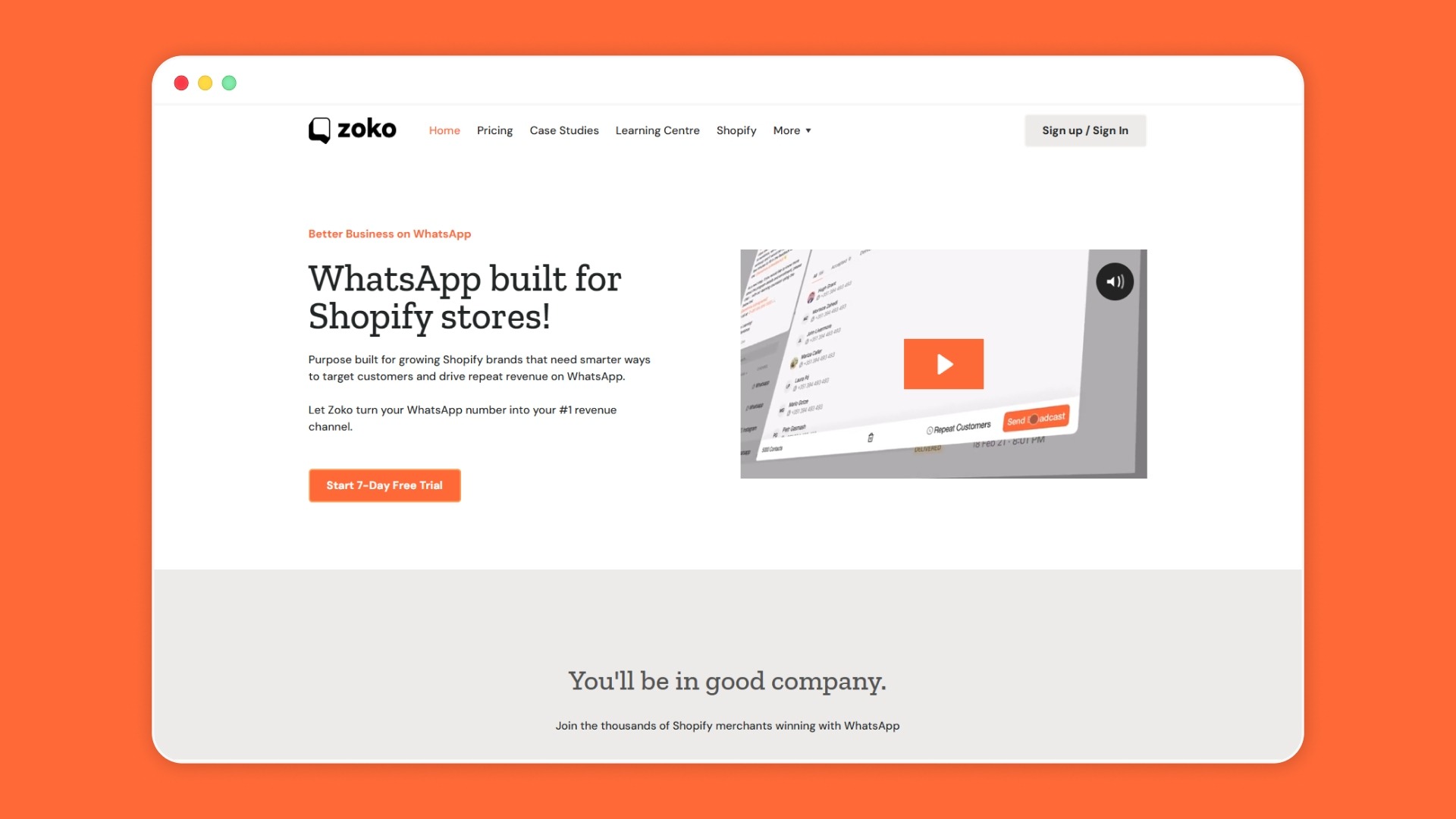
Zoko is the WhatsApp Business API platform built specifically for Shopify merchants. It connects directly to your Shopify store and turns WhatsApp into your most powerful wholesale sales and retention channel.
- Round-the-clock buyer support without added headcount. Zoko's AI-powered chatbots handle common wholesale queries, order status, pricing tiers, and product availability 24/7, so your team focuses on growing accounts.
- One inbox for your entire team. Whether you have 2 or 20 people handling wholesale accounts, Zoko's multi-agent shared inbox gives everyone access to the full conversation history under a single WhatsApp Business number.
- Your Shopify catalog on WhatsApp. Sync your product catalog directly to WhatsApp so buyers can browse and reorder in chat, no login, no friction, no abandoned sessions.
- Broadcast messaging to segmented buyer lists. Send new product launches, seasonal promotions, and stock alerts to specific buyer segments, a boutique list, a specific region, or your top 20 accounts with a few clicks.
- Click-to-WhatsApp Ads. Run Facebook and Instagram ads that open directly into a WhatsApp Business conversation, shortening your B2B sales cycle from days to minutes.
Over 3,000 Shopify brands in 70+ countries are already using Zoko to manage B2B communication, recover lost sales, and drive repeat wholesale revenue. Start your 7-day free trial today!
Also read: Top 10 Best Shopify Apps for Buying wholesale
Also read: Top 10 Best Shopify Apps for Pricing
FAQs
1. What are the wholesale trends in 2026?
Wholesale is shifting toward digital B2B commerce, private label brands, and direct retailer relationships through platforms like Shopify. Messaging channels and automated reorder systems are also becoming central to buyer communication.
2. Which wholesale business is most profitable?
Categories with strong demand and repeat purchases tend to perform best. Health and wellness products, fashion, beauty, home decor, and tech accessories are among the most profitable wholesale niches.
3. Can I buy wholesale and resell?
Yes. Many retailers purchase products in bulk from wholesalers and resell them at a markup. You usually need a reseller permit or seller’s license to do this legally.
4. What is the most sold thing on Shopify?
Popular Shopify categories include fashion, beauty products, health supplements, home decor, and tech accessories. These categories perform well due to high demand and repeat buying behavior.
5. Which big stores use Shopify?
Many well-known brands run their online stores on Shopify, including Gymshark, Allbirds, Kylie Cosmetics, and Heinz. Shopify supports both small businesses and global e-commerce brands.
Interested to know more?
.svg)
Case Studies


















Featured Posts


Continue reading

The E-Commerce Divide: How the Top 10% of Brands Use AI to Grow 5X Faster (And Why It’s Not for Everyone)
Drive Sales with WhatsApp Catalog Integration: Here's How