



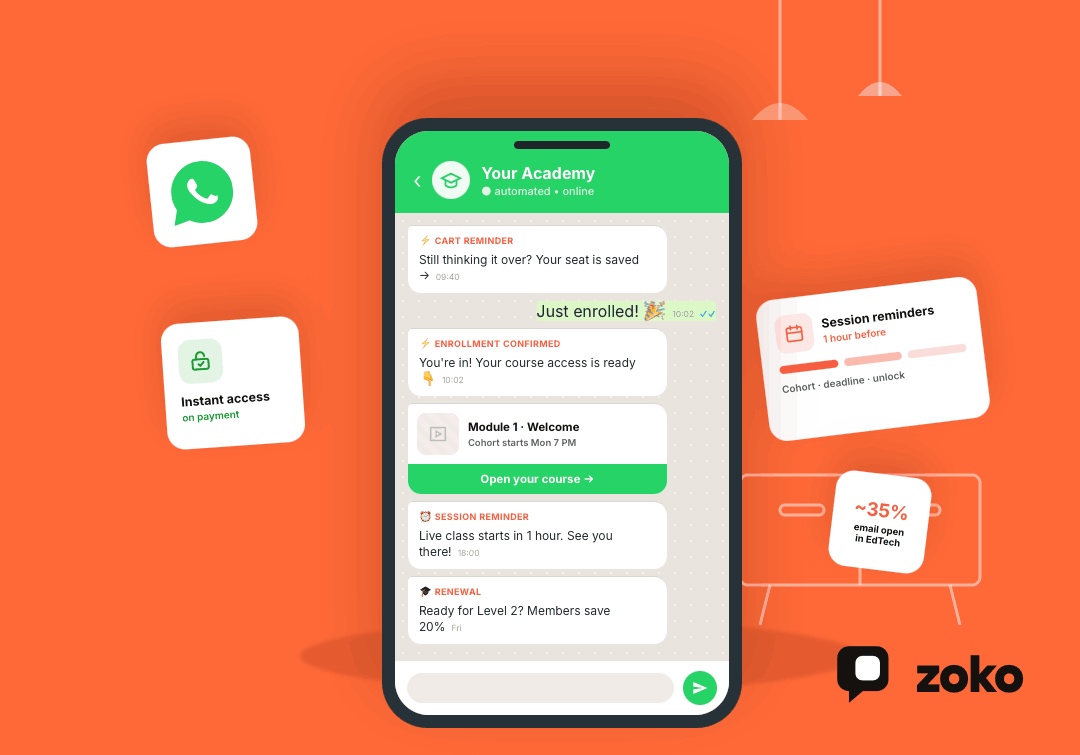


Selling a course or a cohort-based programme through Shopify comes with a communication problem that's a little different from selling a physical product: the moment of purchase isn't the end of the relationship; it's the start of one. That matters because email alone is not always enough for time-sensitive onboarding.
Mailchimp's benchmark data show that the education and training industry averages email open rates in the mid-30% range, meaning a significant share of learners may still miss critical access instructions, session reminders, and cohort updates.
A learner who buys a course still needs to get instant access, show up for the first live session, and stay engaged past week two — and none of that happens reliably with a confirmation email that sits unread.
This article looks at what the WhatsApp Business API actually solves for Shopify-based course creators, cohort programme operators, and EdTech brands selling digital products, where the API alone falls short, and what to weigh before picking a provider.
TL;DR
- For Shopify-based course and EdTech sellers, the highest-impact WhatsApp use cases are checkout recovery, instant access/enrollment delivery, cohort and live-session reminders, and renewal or upsell messaging for repeat learners.
- The WhatsApp Business API is messaging infrastructure only — automation, catalogue browsing, and shared inboxes come from the platform layered on top of it, not the API itself.
- WhatsApp is commonly cited as achieving substantially higher open rates than email, which matters directly for course sellers since abandoned checkouts and unread onboarding emails are lost revenue.
- Every automated message — cart recovery, enrollment confirmation, renewal reminder — still needs to run through Meta's approved template categories and follow opt-in rules; there's no shortcut around this even for transactional-feeling messages.
- When evaluating a provider, prioritise native Shopify order/catalog data, two-way automation for common learner questions, and support for Meta verification over a lower price alone.
Why Course and EdTech Sellers on Shopify Are Turning to WhatsApp
A Shopify store selling a video course, a cohort programme, or a digital download runs into a version of the same drop-off problem every ecommerce store faces at checkout, plus a second one unique to digital and educational products: even after a learner pays, getting them to actually start, show up, and finish is its own battle.
Email struggles on both fronts — checkout recovery emails get buried, and onboarding sequences get skimmed or ignored entirely. WhatsApp closes that gap because it's a channel people already have open, so a checkout reminder or a "your course access is ready" message gets seen in the same way a message from a friend would.
What the WhatsApp Business API Actually Does (and Doesn't Do) for a Course Seller
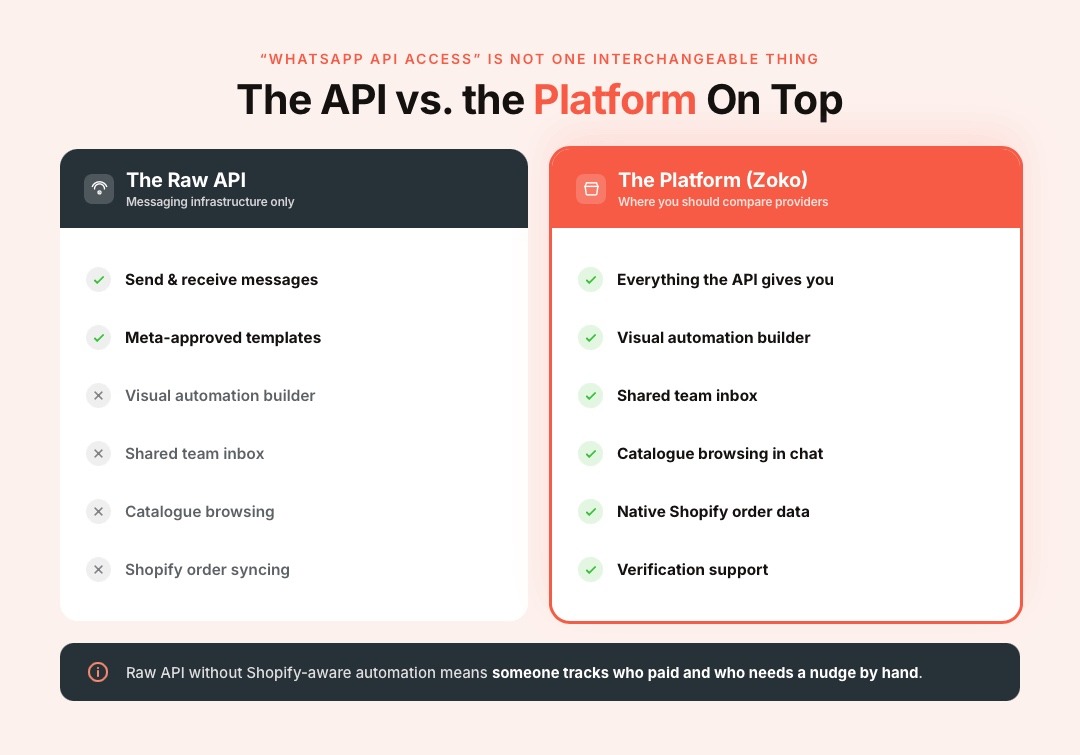
It's worth being precise here, because the API itself is often oversold as more than it is. The WhatsApp Business API is a messaging infrastructure layer — it lets a verified business send and receive WhatsApp messages programmematically, using Meta-approved message templates for anything sent outside a live 24-hour conversation window, as laid out in Meta's own developer documentation on WhatsApp opt-in.
It does not natively include a visual automation builder, a shared team inbox, catalogue browsing, or Shopify order syncing. Those come from the platform built on top of the API — which is exactly where course sellers should be comparing providers, rather than treating "WhatsApp API access" as a single interchangeable thing every provider offers identically.
Where the Gap Actually Shows Up
For a course seller specifically, this distinction matters at the exact moment a customer abandons checkout or needs their access link resent. A provider that only offers the raw API without Shopify-aware automation means someone on your team has to manually track who paid, who didn't, and who needs a nudge — which defeats the purpose of automating this in the first place.
Also read: WhatsApp Automation for Ecommerce: A Practical 2026 Guide
Core Use Cases for Shopify Course and EdTech Sellers
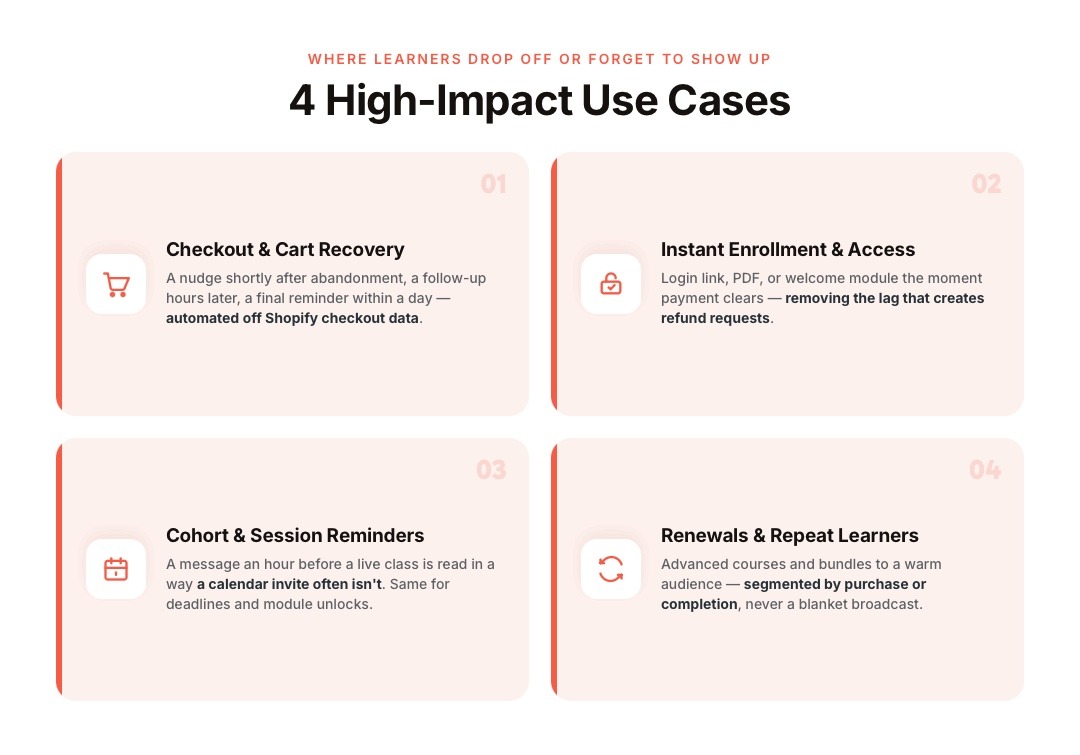
The businesses getting the most out of WhatsApp in this category tend to concentrate on the points where a learner is most likely to drop off or forget to show up.
1. Checkout and Cart Recovery for Course Purchases
Course and digital product checkouts are abandoned at rates comparable to those of any other Shopify product, and WhatsApp-based recovery sequences are commonly cited as recovering a meaningful share of that lost revenue when timed well — a first nudge shortly after abandonment, a follow-up a few hours later, and a final reminder within a day, each sent as an approved marketing or utility template depending on content.
Zoko's Flows automates this sequence directly against Shopify checkout data, rather than requiring a manual export-and-message process.
2. Instant Enrollment and Access Delivery
The moment a learner completes payment, they expect access — a login link, a PDF, a welcome module — without needing to dig through their email. Automating this handoff through WhatsApp, triggered directly by the Shopify order event, removes the lag between payment and access that otherwise creates support tickets and refund requests.
3. Cohort, Live Session, and Deadline Reminders
Cohort-based courses and scheduled live sessions live or die on attendance, and a WhatsApp reminder sent an hour before a session is read in a way a calendar invite often isn't. The same logic applies to assignment deadlines or module unlock dates for self-paced courses — short, timely, and automated rather than requiring a course operator to manually track and send these individually.
4. Renewal, Upsell, and Repeat-Learner Messaging
Once a learner finishes a course or a membership period ends, a targeted WhatsApp message about a renewal, an advanced-level course, or a bundle offer reaches an audience that's already warm — provided the messaging is opted in to and segmented by actual purchase or completion status rather than sent as a blanket broadcast to every past customer, which risks both lower conversion and higher spam-report rates.
What Actually Matters When Evaluating a Provider
Course and EdTech sellers comparing WhatsApp API providers should prioritise native Shopify integration, since checkout recovery, enrollment delivery, and renewal messaging all depend on the platform reading real order and customer data rather than relying on a manually maintained list.
Two-way automation matters just as much as outbound messaging: a learner replying "I didn't get my access link" or "can I switch cohorts" needs to be handled by a flow or routed to a person quickly, not left sitting in a queue — which is the specific problem Zoko's Flows is built to automate through a visual, rule-based builder rather than a basic auto-responder.
A shared inbox becomes necessary once more than one person on a small team is answering learner questions from the same number, so conversations don't get duplicated or dropped. Compliance and verification support carry real weight too, since course sellers are running marketing-category messages (renewals, upsells) at volume — a provider with official Meta Business Partner status offers direct support through account verification and the Blue Tick process, though it's worth being clear that no provider controls Meta's own verification timeline or approval decision.
Finally, WhatsApp's native Catalogue feature matters for sellers running multiple courses or bundles, since it lets a learner browse and buy directly inside the chat rather than being redirected back to the Shopify store.
Where Zoko Exactly Fits
Zoko is built specifically for Shopify-native commerce, which is a meaningfully different starting point than a generic messaging tool with an education use-case page bolted on.
For a course or EdTech seller, that means checkout recovery, enrollment delivery, and renewal messaging run off actual Shopify order and customer data through Zoko Flows, rather than needing a separate integration layer built and maintained by hand.
Sellers can see how Zoko's platform handles this end-to-end, from a shared team inbox for handling learner questions to Meta Business Partner-backed support for account verification.
Also read: WhatsApp Business API Ecommerce Features 2026: What You're Actually Buying
FAQs
1. Is WhatsApp Business API worth it for a small course business with low volume?
It depends on volume and drop-off rate. If checkout abandonment or missed onboarding is a measurable revenue loss even at a small scale, automated WhatsApp recovery can pay for itself quickly; very low-volume sellers may find manual follow-up sufficient until volume grows.
2. Can I send course access links and reminders without the customer opting in first?
No. WhatsApp requires opt-in before a business can message a customer, and this applies to utility-style messages like access delivery and reminders just as it does to marketing messages. Opt-in is typically collected at checkout or through an initial message the customer sends.
3. How is WhatsApp different from an email-based course onboarding sequence?
WhatsApp messages are commonly cited as achieving meaningfully higher open rates than email and support two-way replies within the same thread, which matters when a learner has a quick question about accessing their course that would otherwise sit unanswered in an inbox.
4. Do I need a developer to connect WhatsApp Business API to my Shopify store?
Not necessarily. Most course sellers go through a Shopify-native WhatsApp platform or app that handles the technical setup and Shopify data sync directly, rather than integrating with Meta's raw API, which does require development resources.
5. What's the difference between the WhatsApp Business App and the WhatsApp Business API for a course seller?
The Business App is free but limited to one device and lacks automation, Shopify integration, and multi-agent support. The Business API, accessed through a platform, is built for automating checkout recovery, enrollment, and renewal messaging at the volume a growing course business generates.
6. Can WhatsApp handle a launch-day spike in enrollments without delays?
This depends on the specific platform's infrastructure rather than WhatsApp's API itself. Course sellers running cohort launches or time-limited enrollment windows should ask any provider directly about message throughput during high-volume periods.
7. Are customer and payment data safe when using WhatsApp Business API for course sales?
The WhatsApp Business API operates under Meta's data handling policies, and reputable providers layer additional security practices on top. Sellers handling learner payment or personal data should review a provider's specific data policy rather than assume a default standard.
8. Can WhatsApp Business API integrate with the Shopify course app I already use (like Tevello or Courses Plus)?
This depends on the specific provider and course app combination. Some Shopify-native WhatsApp platforms sync directly with Shopify orders and customer data regardless of which course-delivery app is layered on top, but it's worth confirming the specific integration before committing.
9. How long does WhatsApp Business API verification take for a new Shopify course brand?
Verification and approval timelines are set by Meta and vary based on the completeness of submitted business documentation. No provider can guarantee a fixed timeline, since that decision sits entirely with Meta.
10. Can learners opt out of renewal or upsell messages on WhatsApp?
Yes, and they should be able to. Meta's policies require businesses to honour opt-outs, and a compliant setup includes a clear way for a learner to stop receiving marketing messages while still receiving essential account- or access-related communication where applicable.
Interested to know more?
.svg)
Case Studies













Featured Posts


Continue reading

The E-Commerce Divide: How the Top 10% of Brands Use AI to Grow 5X Faster (And Why It’s Not for Everyone)
Drive Sales with WhatsApp Catalog Integration: Here's How