






MSG91 WhatsApp API Pricing in India: How the Cost Structure Actually Works

MSG91 WhatsApp API Pricing in India: How the Cost Structure Actually Works
Every business comparing MSG91 WhatsApp API pricing eventually runs into the same question: if every provider connects to the same WhatsApp Business Platform, why do the prices look so different?
Part of the confusion stems from how WhatsApp pricing actually works. Since July 2025, Meta has shifted from conversation-based billing to per-message pricing, with charges varying by message category and recipient country. On top of Meta's rates, many Business Solution Providers (BSPs) apply their own platform fees, subscriptions, automation charges, or feature-based pricing—making it difficult to compare providers on price alone.
MSG91 is one of the more visible names in this comparison, largely because it promotes a "no markup" approach to Meta's messaging rates. But choosing a WhatsApp API provider isn't just about the cost of sending a message. It's equally about the platform you're getting around the API—automation, Shopify integration, shared inboxes, campaign management, compliance support, and the operational effort required to run WhatsApp at scale.
This guide breaks down how MSG91 WhatsApp API pricing works, what's charged by Meta versus MSG91, where additional costs may arise, and what Shopify merchants should evaluate before choosing a WhatsApp Business API provider.
TL;DR
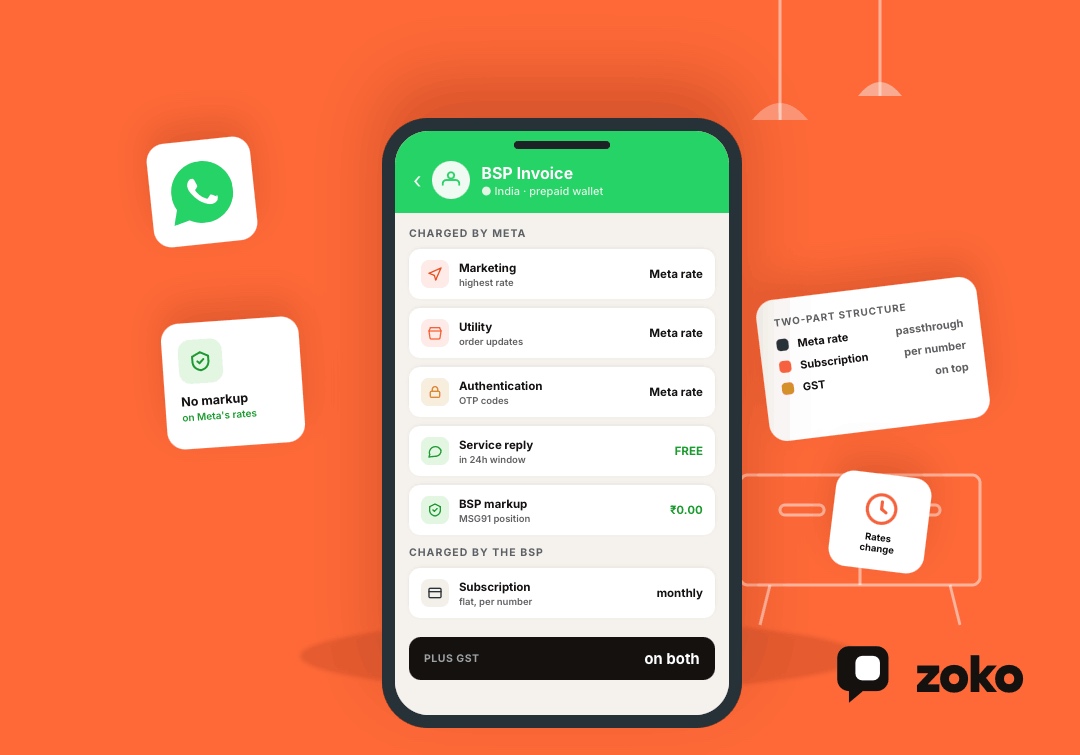
- MSG91's WhatsApp pricing in India follows a two-part structure: a monthly per-number subscription fee, plus Meta's own per-conversation charges for marketing, utility, and authentication messages.
- MSG91's stated differentiator is passing Meta's rates through without adding a markup, unlike some other BSPs that bundle a markup into the per-conversation price.
- Exact rupee figures change periodically since Meta revises its own conversion rates — treat any number quoted in a blog, including this one, as a snapshot rather than a guarantee, and confirm current rates directly on the provider's pricing page.
- Total cost of ownership depends on more than the per-conversation rate: what's bundled into the subscription, how automation and integration features are billed, and how predictably pricing scales with your actual volume.
- For Shopify merchants specifically, a Shopify-native platform's built-in catalogue, order status, and cart recovery automation often affect total ROI more than a small gap in per-message pricing.
How WhatsApp Business API Pricing Works, Structurally
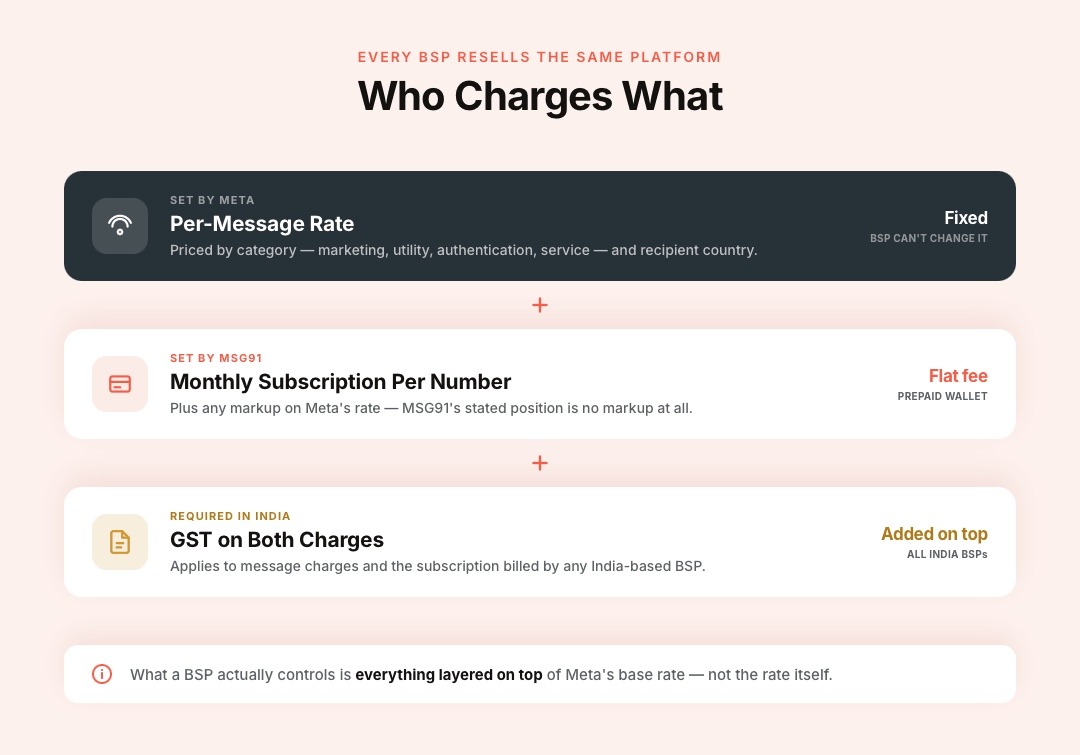
Every WhatsApp Business API provider in India is reselling access to the same underlying WhatsApp Business Platform that Meta operates. This means the actual per-message cost — what Meta calls conversation-based pricing — is set by Meta, not by the BSP.
Meta groups conversations into categories (marketing, utility, authentication, and service), each priced differently, with marketing conversations typically carrying the highest per-conversation rate since they cover promotional and re-engagement messages.
What a BSP like MSG91 actually controls is everything layered on top of that base rate: whether they add a markup to Meta's per-conversation price, what they charge as a monthly platform or number subscription fee, and what tooling (automation, inbox, catalogue, reporting) that subscription includes.
Why Two "Meta Rate" Quotes Can Still Differ
This is the part worth understanding before comparing quotes: two providers can both say "we charge Meta's rate" and still end up costing very differently, because one might charge a higher monthly subscription to make up the difference, or restrict certain features to higher tiers. The headline per-conversation number is rarely the full picture of what you'll actually pay each month.
MSG91's Stated Pricing Model
MSG91 markets its WhatsApp API pricing around a no-markup position — passing through Meta's official per-conversation rates for marketing, utility, and authentication messages, rather than adding a percentage on top of the way a number of other BSPs do, according to MSG91's own pricing page.
Alongside that, it charges a flat monthly subscription fee per WhatsApp number, which it has at times waived for a limited period for new accounts, per MSG91's 2026 WhatsApp pricing update. Billing typically runs on a prepaid wallet model, where a business tops up credit that gets consumed across MSG91's messaging products, with GST applied on top.
Why the Exact Numbers Are a Moving Target
Because Meta periodically revises its own conversation rates — and because promotional waivers and subscription fees are things a provider can change without much notice — treat any specific rupee number you see quoted (including on MSG91's own historical pages) as a snapshot, not a fixed fact.
The reliable move is to check MSG91's current pricing page directly, or ask their sales team for a written quote with the rate date specified, before budgeting against it.
Also read: WhatsApp API for Small Business: A Practical Guide for 2026
What to Actually Compare Beyond the Per-Message Rate
Price-per-conversation is the headline number, but for most Shopify and ecommerce businesses evaluating WhatsApp API providers in India, it's not the number that ends up determining total cost or, more importantly, return on the channel.
Whether the platform is built for commerce or just messaging matters more than it looks: a low per-conversation rate on a tool that only sends broadcasts and can't sync your product catalogue, track abandoned carts, or confirm COD orders means you're paying less per message but doing more manual work around each one.
What's included in the subscription versus billed separately matters too — some platforms bundle automation (visual flow builders), shared team inboxes, and broadcast segmentation into a base subscription, while others charge extra for each, and a provider with a slightly higher monthly fee but a genuinely useful automation layer can end up cheaper in total than a barebones platform charging for every add-on.
Support for compliance and verification matters more once you're running WhatsApp at real volume, where a rejected template or a compliance misstep costs more in lost time than any difference in per-message pricing.
And whether pricing scales predictably matters for businesses with seasonal volume — a wallet-based, pay-as-you-go model works differently from a tiered subscription with message caps, and Indian D2C brands in particular should model both against actual expected conversation volume around festive sales rather than comparing sticker prices.
Where This Fits for a Shopify Merchant Specifically
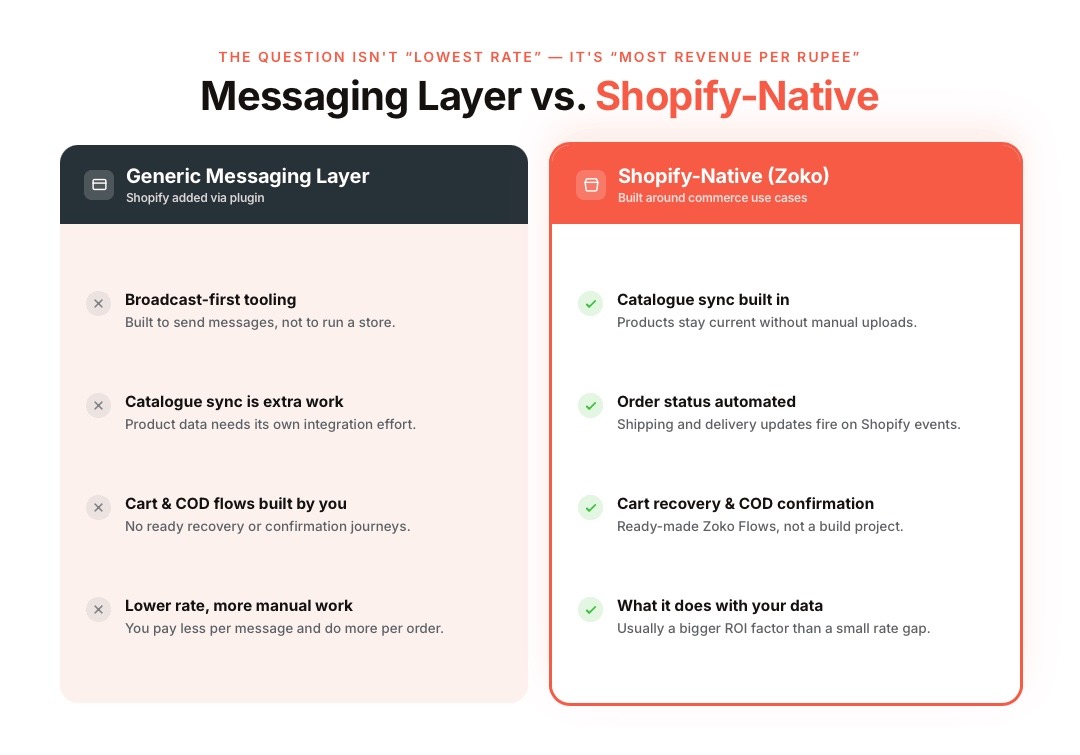
If you're a Shopify store evaluating WhatsApp API pricing, the more useful question isn't "which provider has the lowest per-conversation rate in India" — it's "which provider's total cost, once automation and Shopify integration are factored in, gets me the most revenue-generating use out of WhatsApp."
Zoko, for instance, is built specifically around Shopify-native commerce use cases — catalogue sync, order status updates, abandoned cart recovery, and COD confirmation — through Zoko Flows, rather than as a generic messaging layer retrofitted with a Shopify plugin.
For a merchant weighing MSG91 or any other BSP against a Shopify-native platform like Zoko, that difference in what the platform actually does with your product and order data is usually a bigger factor in ROI than a small gap in per-message pricing.
Also read: MessageBird WhatsApp API Pricing in 2026: What Indian Shopify Sellers Actually Pay
Also read: Gupshup Pricing in 2026: A Full Breakdown for Shopify Stores
FAQs
1. Is MSG91's WhatsApp API pricing the cheapest option in India?
MSG91 markets itself around a no-markup pass-through of Meta's rates, which can make its per-conversation pricing competitive. However, "cheapest" depends on your message mix (marketing vs. utility vs. authentication), your volume, and what's included in the subscription — so it's worth comparing total cost against your actual expected usage rather than a single quoted rate.
2. Does MSG91 charge extra on top of Meta's conversation rates?
MSG91 states it does not add a markup to Meta's official conversation rates for marketing, utility, and authentication messages, charging a separate monthly subscription fee instead. Confirm this directly with MSG91's current pricing page, since terms and promotional waivers can change.
3. What is conversation-based pricing on WhatsApp?
It's Meta's billing model, where each 24-hour conversation window with a customer is billed once, categorised by type (marketing, utility, authentication, or service), rather than charging per individual message sent within that window.
4. Do I need a separate WhatsApp Business API subscription if I already use MSG91 for SMS or OTP?
Typically, yes — WhatsApp API access, SMS, and OTP are usually billed and subscribed to separately even within the same provider's account, though credit wallets are often shared across products.
5. Is GST applicable on WhatsApp API charges in India?
Yes, GST applies on top of message and subscription charges billed by any India-based BSP, MSG91 included.
6. Can I switch WhatsApp API providers without losing my number or chat history?
Number migration between BSPs is generally possible since the number is verified with Meta rather than owned by the provider, but chat history and template approvals typically don't transfer automatically — this is worth confirming with both the outgoing and incoming providers before switching.
7. Does a lower per-conversation rate mean lower total WhatsApp marketing cost?
Not necessarily. Total cost also depends on the subscription fee, what automation and integration features are included versus billed separately, and how efficiently the platform helps you target opted-in customers instead of over-messaging, which increases both cost and spam-report risk.
8.How is WhatsApp API pricing different from WhatsApp Business App, which is free?
The Business App is free but limited to a single device/user and lacks the automation, catalogue integration at scale, and multi-agent support that API-based platforms like MSG91 or Zoko provide — the API pricing reflects that added infrastructure and business-scale support.
9. Does pricing differ for Shopify-specific features like catalogue sync or abandoned cart flows?
This depends entirely on the provider. Some BSPs charge for these as premium add-ons; Shopify-native platforms often build them into the core offering, since that's the primary use case they're designed for. Always confirm what's bundled versus billed separately for Shopify-specific automation.
10. Where can I find MSG91's current, exact pricing figures?
Directly on MSG91's official pricing page, since Meta's conversation rates and MSG91's own subscription terms are revised periodically, any number published in an article — including this one — should be treated as a point-in-time reference, not a guarantee.
Interested to know more?
.svg)
Case Studies













Featured Posts


Continue reading

The E-Commerce Divide: How the Top 10% of Brands Use AI to Grow 5X Faster (And Why It’s Not for Everyone)
Drive Sales with WhatsApp Catalog Integration: Here's How