







WhatsApp’s user base has grown to nearly 2.9 billion globally. Most Shopify customers in India, Brazil, and the UAE already communicate with brands in the app. The platform you choose to send those messages is the one decision that compounds across every campaign, every cart recovery, and every COD confirmation.
Gupshup is one of the common providers in this space. Its pricing is structured but layered, and the rates you see vary a lot. A Shopify merchant doing 5,000 orders a month and a Shopify merchant doing 50,000 pay very different effective rates.
This guide breaks down the Gupshup pricing in detail. You will see what changed in 2026 and what the rates look like in different markets.
Key Takeaways
- Two-layer model: Gupshup charges Meta's per-message rate plus its own platform fee on top of every message.
- Three message types: Marketing, utility, and authentication messages all carry different rates, and marketing is the most expensive.
- 2026 rate shift: Meta moved to per-message billing on January 1, 2026, which changes how every Gupshup quote should be read.
- Setup overhead: Gupshup is built for enterprises, so onboarding, dev work, and ongoing config are outside the per-message cost.
- Shopify fit: For most Shopify stores under enterprise volume, a Shopify-native platform with predictable per-conversation pricing fits better.
How Does Gupshup Pricing Work?
Gupshup pricing has two parts. The first is Meta's per-message rate, which depends on the country your customer is in, the type of message you send (marketing, utility, or authentication), and your monthly volume. The second is Gupshup's own platform fee, charged on top of every message Meta charges for.
The result is a per-message bill that varies by country, category, and scale. Gupshup does not publish a single flat rate. Your effective cost depends on which markets you sell into and which mix of messages you run.
Suggested Read: A Complete Guide to WhatsApp API Pricing
What Changed in 2026 (Per-Message Billing)
Meta moved from per-conversation to per-message billing effective January 1, 2026. Every WhatsApp Business API message now carries its own line-item charge instead of being bundled into a twenty-four-hour conversation window. For Shopify merchants, this changes how you forecast costs and how you read any Gupshup quote.
Under the older model, multiple messages inside one twenty-four-hour window counted as a single conversation. Under the new model, each message is billed independently. That makes high-frequency flows (multi-touch cart recovery, longer support threads) more expensive than they used to be.
Two practical effects to plan for:
- Cart recovery rhythm: Three recovery touches now cost three messages instead of one conversation. The campaign math shifts, so audit your cart recovery flow to make sure each touch earns its cost.
- Support threads: A back-and-forth support exchange now meters per message, so longer threads cost more than they did a year ago.
If you are checking any Gupshup quote dated before January 2026, note that the conversation-based math no longer applies.
Gupshup Pricing by Market: India, Brazil, UAE, Spain
Marketing, utility, and authentication rates vary widely by country, which means a Shopify store's bill depends heavily on where its customers live. India is among the lowest-cost markets globally. Brazil sits in the middle. The UAE costs more. Spain costs the most of these four.
Here is a quick view of per-message rates across four common Shopify markets.
| Market | Marketing | Utility | Authentication |
|---|---|---|---|
| India | $0.0118 | $0.0014 | $0.0014 |
| Brazil | $0.0625 | $0.0068 | $0.0068 |
| UAE | $0.0499 | $0.0157 | $0.0157 |
| Spain | $0.0615 | $0.0200 | $0.0200 |
These rates are the Meta base. Gupshup's platform fee gets added on top of each one.
Note: There are also additional cost lines that catalog-heavy stores need to account for, like template approvals and media charges. If you sell into multiple markets, model each one separately.
Also Read: WhatsApp Marketing Strategies for Emerging Markets
Also read: MessageBird WhatsApp API Pricing in 2026: What Indian Shopify Sellers Actually Pay
Where Gupshup Pricing Fits (and Where It Limits)
Gupshup's pricing fits high-volume senders. Once a merchant crosses tens of millions of messages a month, the volume tier discounts, the dedicated account support, and the platform's enterprise tooling earn their cost.
The limitation is mainly for Shopify-sized merchants, where the same per-message logic plus a platform fee adds up faster than expected, and onboarding takes longer than the store has time for.
Here are the signals that suggest Gupshup pricing fits your operation:
- Enterprise volume: You send more than 100,000 utility or marketing messages a month consistently.
- Multi-channel needs: You need SMS, RCS, voice, and WhatsApp through one provider, not just WhatsApp.
- In-house dev team: You have engineers who can run the API setup and manage template approvals.
- Long sales cycle is okay: You can absorb a multi-week onboarding and contract negotiation.
If most of these are not suitable for your store, the pricing model will feel heavier than the value you get.
Tip: For more granular platform comparisons across the WhatsApp Business API space, look at how each provider packages support, agent seats, and template management. The published rate rarely gives you the full picture.
Common Pricing Surprises Shopify Merchants Run Into
Per-message rate cards hide the cost lines that actually decide what a Shopify store pays. The published rate is the start of the conversation, not the end. Most of these surprises trace back to common costly marketing mistakes that show up after a contract is signed.
Here are the line items that most often catch operators after sign-up:
- Platform fee on top of Meta's rate. The Meta rate card is the base. Gupshup's per-message platform charge sits on top of every message. Budget on the combined number, not the rate-card number.
- Setup and onboarding cost. Many enterprise-grade providers price API setup, template approvals, and account configuration as separate line items. A Shopify store paying this on top of the monthly messaging cost can spend more on setup than the first quarter of usage.
- Volume tier thresholds. Discounts of five to thirty percent are real, but the first tier often starts at 100,000 utility messages or 300,000 marketing messages a month. Most Shopify stores never hit those thresholds.
- Cross-border authentication rates. Sending one-time passwords to customers outside your home country uses the international authentication rate, which is multiples higher. A store in India sending OTPs to UAE customers pays the UAE international authentication rate, not the Indian rate.
- No Shopify-native flows. Cart recovery, COD confirmation, and reorder reminders need to be built. A platform with native Shopify-WhatsApp integration ships these flows pre-built; with Gupshup, you have to build and maintain.
Each of these mistakes is solvable, though. The point is to count them before the contract, not after.
Run WhatsApp on Pricing Built for Shopify Stores with Zoko
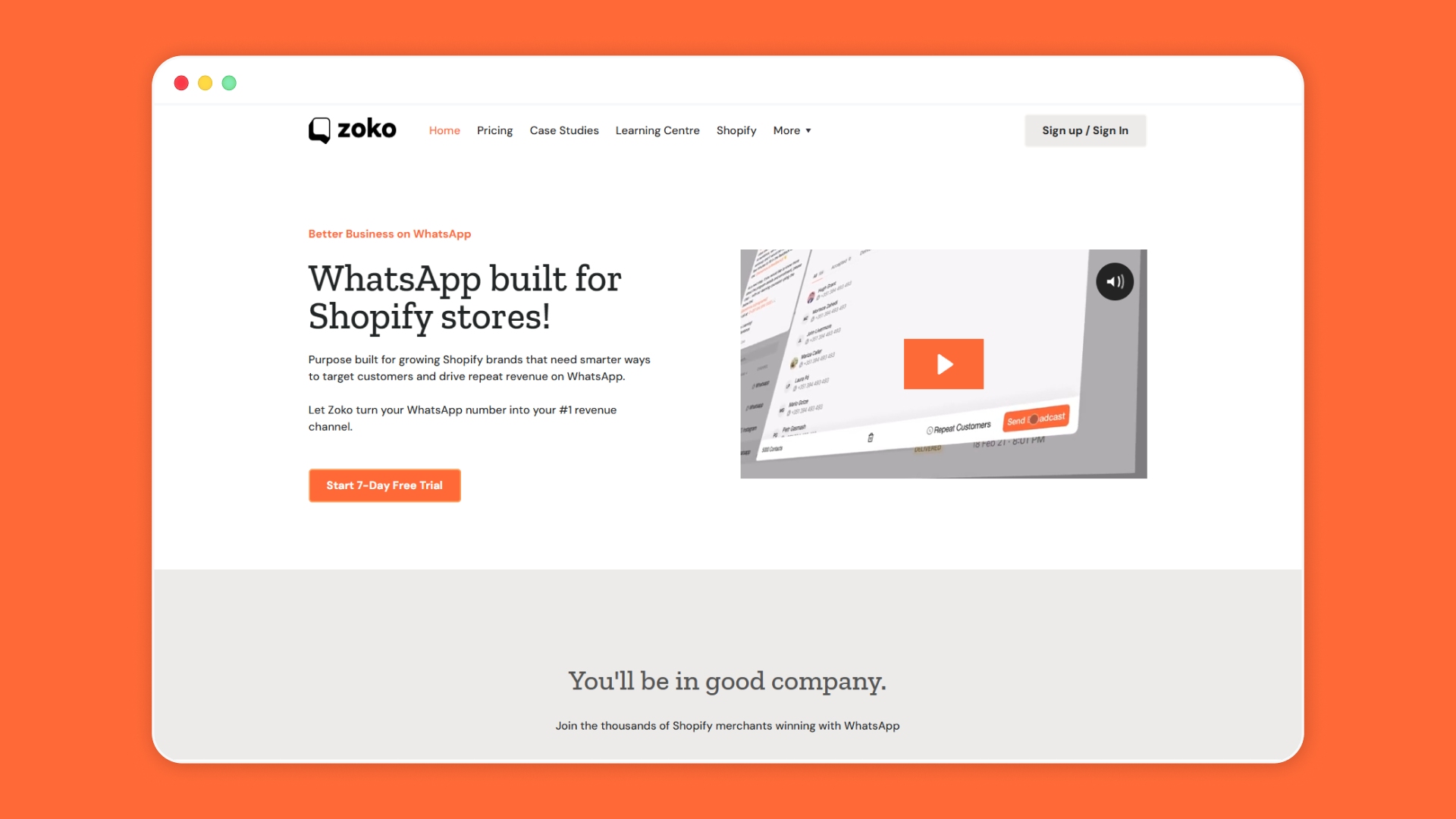
For most Shopify stores, the math gets simpler when the platform is built around how a Shopify merchant actually works. Zoko is a WhatsApp Business platform built specifically for Shopify, with predictable per-conversation pricing on plans above Starter, pre-built flows for the common Shopify use cases, and an Official Meta Business Partner setup that takes most stores only a few minutes.
Zoko gives Shopify merchants the tools they actually need:
- WhatsApp Catalog: Auto-syncs the Shopify catalog into WhatsApp so customers can browse and order inside the chat.
- Abandoned cart recovery: Pre-built flow recovers carts via WhatsApp without dev work.
- CTWA Ads: Run Click-to-WhatsApp ads that route directly into a managed inbox.
- Unified inbox: Manage WhatsApp, Facebook, and Instagram chats from one screen with multi-agent routing.
Purplle handles 40K customer chats a month on Zoko's unified inbox and got the system live in under a day. The economics worked because a single screen handled the volume, and routing rules kept the queue moving.
See Zoko's pricing to compare per-conversation plans against what Gupshup would cost at your volume.
Final Thoughts
Gupshup pricing makes sense once you separate the Meta rate, the platform fee, and the country mix that drives your monthly bill. Run the numbers at your actual volume and your actual message mix before you sign anything. The cost of an enterprise-grade contract for a Shopify-sized store shows up in setup time, support delays, and per-message rates that never trip the volume tier discounts.
Zoko gives Shopify merchants predictable per-conversation pricing on a platform built around the Shopify workflow, with cart recovery, catalog, and a unified inbox included from day one. Start your 7-day free trial and see what a Shopify-sized WhatsApp bill actually looks like.
Also read: WhatsApp Business API: Top 7 Best Practices for 2026
FAQs
1. Is Gupshup expensive for a small Shopify store?
Gupshup pricing scales with monthly message volume, and the platform's lowest effective rates appear at enterprise volumes. Small Shopify stores rarely hit those thresholds, so the per-message cost plus platform fee can feel heavy compared to platforms built for smaller operations.
2. Does Gupshup charge for incoming messages?
The WhatsApp Business API model bills outgoing business-initiated messages by category. Incoming customer messages do not carry the same per-message charge, although platforms apply their own usage rules. Always confirm the exact billing logic on your specific contract before sending.
3. What is the cheapest WhatsApp Business API country?
India is among the cheapest markets globally for WhatsApp Business API messaging, especially for utility and authentication categories. Other low-cost markets include Colombia and Turkey. Markets like Germany, the Netherlands, and the UK sit at the higher end of the rate scale.
4. How is per-message billing different from per-conversation billing?
Per-conversation billing bundles multiple messages within a fixed time window into a single charge. Per-message billing charges each outgoing business message individually. The switch makes multi-touch flows like cart recovery and longer support threads more expensive than they were under the older model.
5. Do I need a developer to use Gupshup?
Gupshup is built for enterprise integration, so most setups involve API work, template approval, and dashboard configuration that a developer or technical operator handles. Smaller Shopify stores without in-house engineering often find the setup time longer than they expected.
6. What is the difference between marketing, utility, and authentication messages?
Marketing messages are promotional, like sale broadcasts and offers, and carry the highest per-message rate. Utility messages cover order updates, shipping notifications, and reminders. Authentication messages are one-time passwords and verification codes, usually priced close to utility rates within the same country.
Interested to know more?
.svg)
Case Studies





















Featured Posts


Continue reading

The E-Commerce Divide: How the Top 10% of Brands Use AI to Grow 5X Faster (And Why It’s Not for Everyone)
Drive Sales with WhatsApp Catalog Integration: Here's How