



D2C Brand Marketing: 12 Strategies for Profitable Growth in 2026

D2C Brand Marketing: 12 Strategies for Profitable Growth in 2026
D2C brands control their products, pricing, customer data, and buying experience. They also carry full responsibility for creating demand, converting shoppers, fulfilling orders, and earning repeat purchases.
That responsibility is growing as India’s e-retail market expands. Bain expects Indian e-retail to grow at more than 20% annually and reach $170–$180 billion in gross merchandise value by 2030. However, online retail still represents only about 1.6% of India’s GDP, leaving significant room for new brands and customers.
Growth alone does not make a D2C business profitable. Rising acquisition costs, high cart abandonment rates, COD returns, weak differentiation, and low repeat purchase rates can quickly erode margins.
Successful D2C brand marketing in 2026 therefore requires more than social media advertisements. Brands need a connected system to manage positioning, customer acquisition, conversion, direct communication, the order experience, and retention.
Quick Answer
D2C brand marketing is the process of promoting products directly to consumers through channels controlled or managed by the brand. A complete D2C marketing strategy combines:
- Clear positioning and customer research
- Search-led educational content
- Social media and creator partnerships
- Paid customer acquisition
- Conversion-focused product pages
- First-party customer data
- Email and WhatsApp communication
- Abandoned cart recovery
- Post-purchase automation
- Loyalty and referral programs
- Customer support
- Retention and win-back campaigns
The goal is not only to generate first-time orders. Strong D2C marketing increases contribution margin, repeat purchases, customer lifetime value, referrals, and long-term brand recognition.
What Is D2C Brand Marketing?
Direct-to-consumer, or D2C, is a retail model in which brands sell directly to customers instead of depending entirely on wholesalers, distributors, or traditional retailers.
The brand owns more of the customer journey, including:
- Product discovery
- Customer education
- Product comparison
- Checkout
- Payment
- Fulfillment
- Support
- Retention
This gives D2C companies greater control over pricing, brand presentation, customer communication, and first-party data. It also means the brand must create its own demand instead of relying on retail footfall or marketplace discovery.
| Traditional Retail Marketing | D2C Brand Marketing |
|---|---|
| Retailers influence the customer relationship | The brand communicates directly with customers |
| Customer data may remain with intermediaries | The brand collects first-party customer data |
| Products compete for physical shelf space | Products compete for digital attention |
| Retailers influence presentation and promotions | The brand controls presentation and promotions |
| Feedback passes through intermediaries | Customers share feedback directly |
| Marketing may stop after the sale | Marketing continues after delivery |
D2C vs. Marketplace vs. Omnichannel Marketing
D2C does not necessarily mean selling through only one website. Many modern brands combine their own store with marketplaces, quick-commerce platforms, social channels, messaging, and physical retail.
| Model | Main advantage | Main limitation |
|---|---|---|
| Brand-owned D2C store | Greater control over data, margins, and customer experience | The brand must generate its own traffic |
| Online marketplace | Existing demand and wider discovery | Limited customer ownership and stronger price competition |
| Quick commerce | Fast delivery and high purchase convenience | Platform fees and limited control over presentation |
| Physical retail | Product trial and local trust | Higher operational and expansion costs |
| Omnichannel | More customer access across connected channels | Requires consistent data, inventory, and communication |
The strongest model depends on the product category, order frequency, margins, customer behavior, and operational capacity.
A beauty brand may use creators for discovery, its Shopify store for education, WhatsApp for purchase questions, marketplaces for reach, and quick commerce for urgent reorders.
Why D2C Marketing Needs a New Approach in 2026
The path from product discovery to purchase is becoming less linear.
A customer may:
- Discover a product through a creator
- Read reviews on social media
- Search for comparisons on Google
- Ask a question through WhatsApp
- Purchase through a Shopify store
- Track delivery through messaging
- Reorder through a reminder
More than half of Indian retail consumers research products online before purchasing in-store, while a similar share researches products in-store before purchasing online. Omnichannel shoppers also spend 2.5 times more than customers who use only one channel.
Several shifts now affect D2C marketing.
Customer Acquisition Is Becoming More Expensive
Paid advertising remains valuable, but brands cannot depend on it for every purchase. Increasing acquisition pressure makes conversion, retention, referrals, and organic discovery more important.
Discovery Is Becoming Video- and Creator-Led
Short-form video helps customers discover products, understand how to use them, and evaluate social proof. Retail brands using Reels and creators have reported a 71% higher brand-intent lift and a 19% lower acquisition cost in Meta and RAI research.
Commerce Is Becoming Conversational
Customers increasingly want to ask questions before purchasing. Product pages may provide information, but chat helps resolve personal concerns around fit, sizing, ingredients, delivery, COD, or returns.
Profitability Is Becoming More Important Than Platform ROAS
A campaign can report strong return on ad spend while attracting customers who purchase only once, use large discounts, or create expensive returns.
D2C teams need to track contribution margin, blended acquisition cost, repeat purchases, and customer lifetime value alongside revenue.
The D2C Marketing Funnel
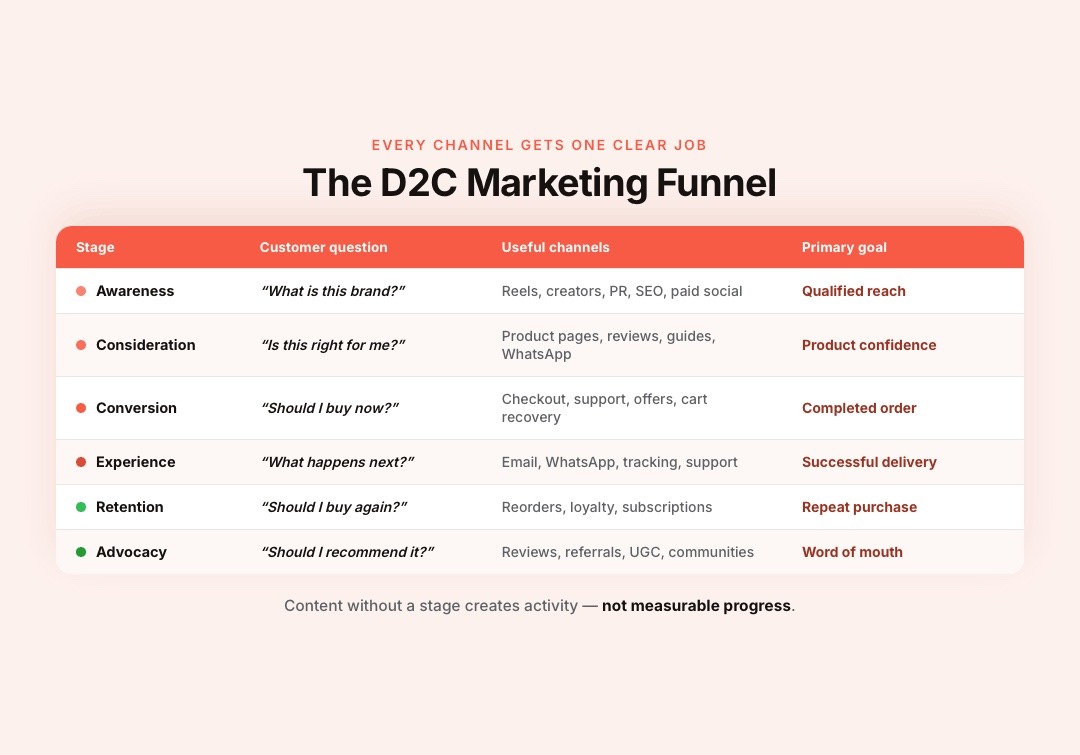
A useful D2C funnel assigns a clear role to each marketing channel.
| Funnel stage | Customer question | Useful channels | Primary goal |
|---|---|---|---|
| Awareness | “What is this brand?” | Reels, creators, PR, SEO, paid social | Qualified reach |
| Consideration | “Is this right for me?” | Product pages, reviews, guides, WhatsApp | Product confidence |
| Conversion | “Should I buy now?” | Checkout, support, offers, cart recovery | Completed order |
| Experience | “What happens after purchase?” | Email, WhatsApp, tracking, support | Successful delivery |
| Retention | “Should I buy again?” | Reorders, loyalty, subscriptions, recommendations | Repeat purchase |
| Advocacy | “Should I recommend it?” | Reviews, referrals, UGC, communities | Word of mouth |
A channel should solve a specific customer problem at a specific stage. Publishing content or sending campaigns without that connection creates activity without measurable progress.
1. Build Clear Brand Positioning
Customers should quickly understand:
- Who the product serves
- What problem it solves
- Why the solution is different
- Why they should trust the brand
- Why they should choose it now
Weak positioning depends on broad claims such as:
- Premium quality
- Natural ingredients
- Affordable prices
- Made with care
- Designed for everyone
These claims may sound positive, but competitors can repeat them easily.
Strong positioning makes a specific promise to a specific customer. For example, a skincare brand could focus on simple routines for humid Indian climates rather than describing every product as clean and luxurious.
A useful positioning statement can follow this structure:
For [specific customer], our product helps solve [specific problem] through [credible differentiator], unlike [common alternative].
Use the same core positioning across:
- Homepage copy
- Product pages
- Paid advertisements
- Packaging
- Social media
- Creator briefs
- WhatsApp messages
- Customer support
The format may change across channels, but the central promise should remain recognizable.
2. Define Your Ideal Customer and Behavioral Segments
A broad audience description such as “women aged 18 to 45” rarely explains what customers want, what stops them from buying, or what message they need next.
Start with an ideal customer profile covering:
- Primary problem
- Desired result
- Product awareness
- Common objections
- Purchase triggers
- Preferred channels
- Typical order value
- Reorder frequency
Then segment customers according to actual behavior.
Useful D2C segments include:
- First-time website visitors
- Repeat visitors
- Product viewers
- Cart abandoners
- First-time buyers
- Repeat customers
- High-value customers
- Discount-driven buyers
- Customers due for replenishment
- Customers who have become inactive
Each segment needs a different message.
A first-time visitor may need product education. A cart abandoner may need clarification around delivery or returns. A repeat customer may respond better to a replenishment reminder than a first-order discount.
3. Improve Product Pages Before Increasing Traffic
Paid campaigns cannot compensate for a confusing product page.
A high-converting D2C product page should answer:
- What is the product?
- Who is it for?
- What problem does it solve?
- How is it used?
- What makes it different?
- When can the customer expect results?
- What is included?
- How long will delivery take?
- What is the return policy?
- Which payment options are available?
Useful product-page elements include:
- Clear product images
- Short demonstration videos
- Benefit-led copy
- Ingredient or material details
- Size and usage guidance
- Customer reviews
- Frequently asked questions
- Delivery information
- Return details
- Relevant trust signals
- Access to customer support
Match the page content to the advertisement or search query that brought the visitor there. A customer clicking an ad about sensitive-skin suitability should reach a page that answers that concern immediately.
4. Build Search-Led Educational Content
Search content helps customers discover the brand while researching a problem, product category, or buying decision.
Useful D2C content formats include:
- Product comparison guides
- “Best product for” articles
- Ingredient or material explainers
- Product selection guides
- How-to tutorials
- Size guides
- Product-care instructions
- Customer stories
- Use-case pages
- Frequently asked questions
A haircare brand could create content around:
- Choosing products by hair type
- Building a wash-day routine
- Understanding specific ingredients
- Preventing common product mistakes
- Comparing product formats
Each article should connect naturally to a product, category, or customer journey. Traffic that has no relationship with the brand’s offer may improve pageviews without improving sales.
SEO content also helps GEO and AEO when it includes:
- Direct answers
- Clear definitions
- Comparison tables
- Step-by-step instructions
- Specific examples
- Relevant statistics
- Concise FAQ answers
- Well-supported claims
5. Combine Creator Marketing With Customer Content
Creators help brands explain products in contexts customers understand. Customer-generated content adds proof after shoppers reach the website or product page.
Choose creators based on:
- Audience relevance
- Category credibility
- Content quality
- Communication style
- Engagement quality
- Brand fit
- Previous product partnerships
Follower count alone does not show whether a creator can explain the product or influence the right audience.
Ask creators to demonstrate:
- How they use the product
- What problem it solves
- Their experience before and after use
- Who should consider it
- Important limitations
- How the product fits into daily life
Strong creator assets can support:
- Organic social posts
- Paid partnership ads
- Product pages
- Landing pages
- Email campaigns
- WhatsApp campaigns
- Retargeting advertisements
Customer reviews, photos, and videos can then reinforce the same claims with broader social proof.
6. Connect Paid Advertising With Unit Economics
Paid media should support the customer journey rather than act as a separate revenue machine.
Build campaigns for different stages:
Awareness Campaigns
Use these to introduce the customer problem, product category, and brand viewpoint.
Measure:
- Qualified reach
- Video completion
- Brand searches
- New visitors
- Assisted conversions
Consideration Campaigns
Use demonstrations, comparisons, reviews, and creator content to build product confidence.
Measure:
- Product-page visits
- Time on page
- Add-to-cart rate
- Support conversations
- Return visits
Conversion Campaigns
Retarget interested shoppers with relevant products, proof, support, or carefully selected offers.
Measure:
- Checkout completion
- Customer acquisition cost
- First-order contribution margin
- New-customer revenue
Retention Campaigns
Promote replenishment, complementary products, subscriptions, and loyalty benefits to existing customers.
Measure:
- Repeat purchase rate
- Time to second order
- Reorder revenue
- Customer lifetime value
Do not judge every campaign through immediate return on ad spend. A campaign that attracts profitable repeat customers may create more value than one generating many discounted first orders.
7. Build First-Party Customer Relationships
Marketplaces and advertising platforms help brands reach customers, but the platform often controls the audience relationship and behavioral data.
First-party channels give brands a direct connection through:
- Email
- WhatsApp
- Customer accounts
- Loyalty programs
- Subscriptions
- Product registrations
- Quizzes
- Surveys
- Offline events
Shopify notes that platform-owned acquisition can leave brands repeatedly paying to reach customers they cannot confidently recognize across channels. Better customer identity helps brands separate new buyers from existing customers and improve personalization.
Create useful reasons for customers to opt in, including:
- Back-in-stock alerts
- Order updates
- Early product access
- Personalized recommendations
- Replenishment reminders
- Educational content
- Loyalty benefits
- Member-only launches
Explain what customers will receive and how often they will hear from the brand. First-party data should increase relevance, not justify excessive messaging.
Also read: Top 9 Customer Retention Strategies for E-Commerce in 2026
8. Use WhatsApp for Conversational Commerce
Customers often need answers before they feel ready to purchase. WhatsApp turns these questions into direct sales conversations.
D2C brands can use WhatsApp for:
- Product discovery
- Personalized recommendations
- Back-in-stock alerts
- New product launches
- Segmented campaigns
- Abandoned cart recovery
- COD confirmation
- Payment communication
- Order updates
- Delivery support
- Review collection
- Reorder reminders
Meta and RAI report that WhatsApp now plays a major role in Indian retail discovery. Retailers using Business Messaging and Click-to-WhatsApp campaigns reported a 61% average improvement in ROAS, a 62% increase in leads, and 22% higher order values. These are reported averages from participating retailers, not guaranteed results for every campaign.
A strong WhatsApp strategy connects customer messages with actual store activity.
For example:
- A customer views a product and asks a sizing question.
- An agent or chatbot provides relevant guidance.
- The customer begins checkout but does not finish.
- An automated reminder restores the checkout.
- The customer places a COD order.
- A confirmation workflow verifies the order.
- Shipping updates reduce support requests.
- A later message asks for a review or triggers a reorder.
This creates one connected conversation instead of separate marketing, support, and order channels.
9. Reduce Checkout Friction and Recover Abandoned Carts
The average documented online cart abandonment rate is 70.22%, based on Baymard’s aggregation of 50 studies.
Customers may abandon checkout because of:
- Unexpected shipping charges
- Slow delivery
- Forced account creation
- Limited payment options
- Complicated forms
- Unclear return policies
- Payment failures
- Product doubts
- Distractions
- Lack of trust
Start by fixing checkout friction. Recovery messages cannot solve a poor checkout experience permanently.
A useful cart recovery workflow should:
- Detect the incomplete checkout
- Allow a reasonable waiting period
- Remind the customer about the product
- Restore the checkout directly
- Answer common objections
- Offer access to human support
- Stop immediately after purchase
Avoid adding a discount to every reminder. Customers may only need delivery information, payment assistance, or reassurance about returns.
Read more about WhatsApp abandoned cart recovery for Shopify stores.
10. Turn Post-Purchase Communication Into Retention
The customer relationship should not disappear after checkout.
Post-purchase communication shapes whether the customer:
- Trusts the brand
- Accepts the delivery
- Uses the product correctly
- Leaves a positive review
- Contacts support
- Purchases again
- Recommends the product
Useful post-purchase messages include:
- Order confirmation
- COD verification
- Payment receipt
- Shipping update
- Delivery notification
- Usage instructions
- Product-care guidance
- Review request
- Replenishment reminder
- Complementary recommendation
Retention reduces the pressure to acquire a completely new customer for every sale. Shopify recommends measuring repeat purchase and cohort retention, then testing focused post-purchase, loyalty, and referral initiatives.
The ideal follow-up timing depends on the product.
A skincare product may need several weeks before review collection. A consumable product may require a reorder reminder based on expected usage. An apparel brand may introduce a complementary product after successful delivery.
11. Build Loyalty, Referrals, and Community
Discounts may encourage another purchase, but loyalty needs a broader reason to continue choosing the brand.
D2C loyalty can come from:
- Consistent product quality
- Useful customer support
- Easy returns
- Recognizable positioning
- Personalized communication
- Exclusive access
- Customer recognition
- Community participation
- Referral rewards
A loyalty program may offer:
- Points for purchases
- Referral credits
- Early product access
- Birthday benefits
- Product samples
- Member-only bundles
- Free delivery thresholds
- Replenishment benefits
Shopify’s November 2025 merchant survey found that 53% of merchants relied on word of mouth as their primary first-year growth strategy.
Create a review and referral process after customers have had enough time to experience the product. Asking immediately after checkout produces weak feedback and feels transactional.
12. Prepare for Omnichannel and Regional Growth
D2C brands are increasingly expanding beyond their own websites.
Potential channels include:
- Marketplaces
- Quick-commerce apps
- Physical stores
- Pop-up events
- Social commerce
- WhatsApp
- Distributor partnerships
- International storefronts
Expansion should not create a fragmented customer experience.
Keep these elements consistent:
- Product information
- Pricing rules
- Promotions
- Inventory
- Support policies
- Delivery expectations
- Returns
- Brand messaging
Regional expansion also requires more than translating advertisements.
Consider:
- Local languages
- Regional creators
- Climate and usage differences
- Payment preferences
- COD behavior
- Delivery coverage
- Cultural events
- Local product demand
Bain expects conversational commerce and quick commerce to remain important parts of India’s evolving e-retail market. It also notes substantial growth potential among internet users who already use chat and social platforms but have not yet purchased online.
How to Allocate a D2C Marketing Budget
There is no universal percentage that fits every D2C brand. Budget allocation should reflect the company’s growth stage and biggest constraint.
| Business situation | Primary investment areas |
|---|---|
| Low brand awareness | Creators, paid reach, social content, PR |
| Strong traffic but weak sales | Product pages, checkout, support, CRO |
| High acquisition cost | SEO, referrals, conversion, retention |
| Low repeat purchase rate | Post-purchase journeys, reorders, loyalty |
| High COD returns | Confirmation workflows, prepaid conversion, delivery communication |
| Strong online sales but limited reach | Marketplaces, retail, quick commerce, regional expansion |
Protect part of the budget for experimentation. Do not commit the complete budget to channels that worked during one short period.
A simple allocation model may include:
- Core proven acquisition channels
- Organic and brand-building channels
- Conversion improvements
- Retention programs
- Controlled experiments
The exact percentages should change as customer behavior and unit economics change.
D2C Brand Marketing Metrics to Track
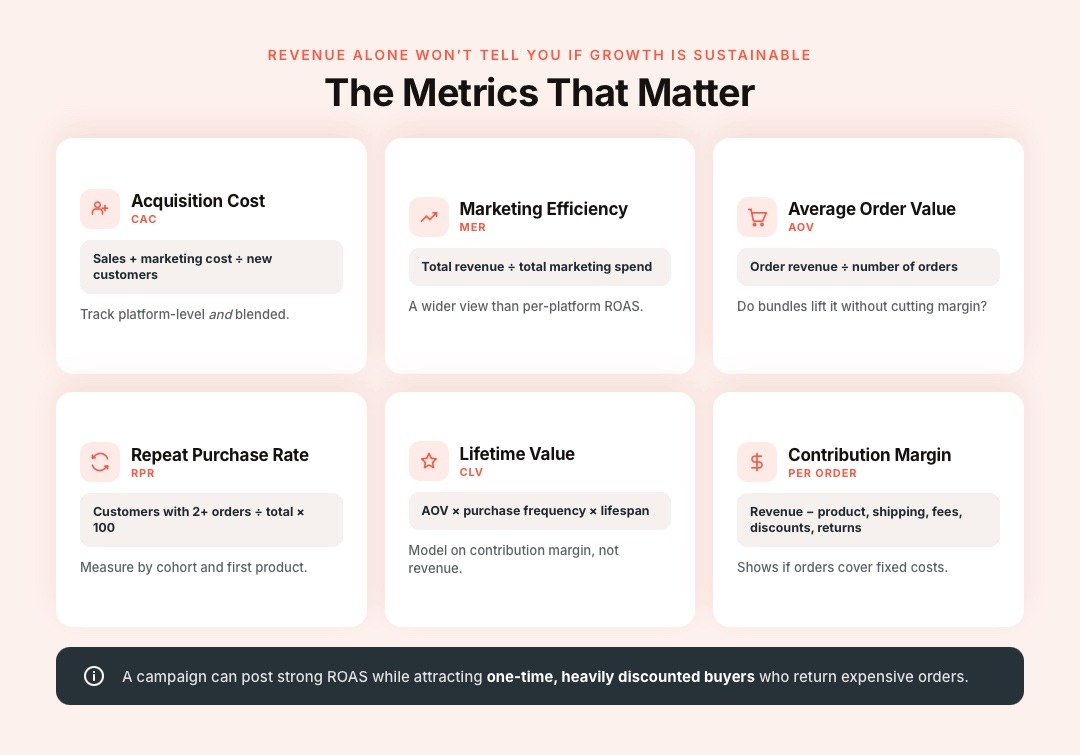
Revenue alone does not show whether marketing creates sustainable growth.
Customer Acquisition Cost
CAC = Total sales and marketing costs ÷ Number of new customers acquired
Calculate both platform-level and blended CAC.
Marketing Efficiency Ratio
MER = Total revenue ÷ Total marketing spend
MER provides a wider business view than individual platform ROAS.
Average Order Value
AOV = Total order revenue ÷ Number of orders
Review whether bundles, cross-sells, and payment options improve AOV without reducing margin.
Repeat Purchase Rate
Repeat purchase rate = Customers who purchased more than once ÷ Total customers × 100
Measure this by customer cohort and first-purchase product.
Customer Lifetime Value
CLV estimates how much value a customer generates throughout the relationship.
A simple model is:
CLV = Average order value × Purchase frequency × Average customer lifespan
Use contribution margin rather than gross revenue for more realistic planning.
Contribution Margin
Subtract variable costs such as:
- Product costs
- Shipping
- Payment fees
- Discounts
- Packaging
- Marketplace fees
- Returns
This reveals whether each order contributes enough to cover fixed operating costs.
Additional Metrics
| Goal | Metrics |
|---|---|
| Brand awareness | Branded searches, direct traffic, qualified reach |
| Acquisition | CAC, new-customer conversion, first-order margin |
| Conversion | Add-to-cart rate, checkout completion, cart recovery |
| Engagement | Replies, clicks, saves, opt-outs |
| Experience | Support response time, delivery success, return rate |
| Retention | Repeat purchase rate, reorder rate, cohort retention |
| Advocacy | Reviews, referrals, customer-generated content |
A 90-Day D2C Marketing Plan
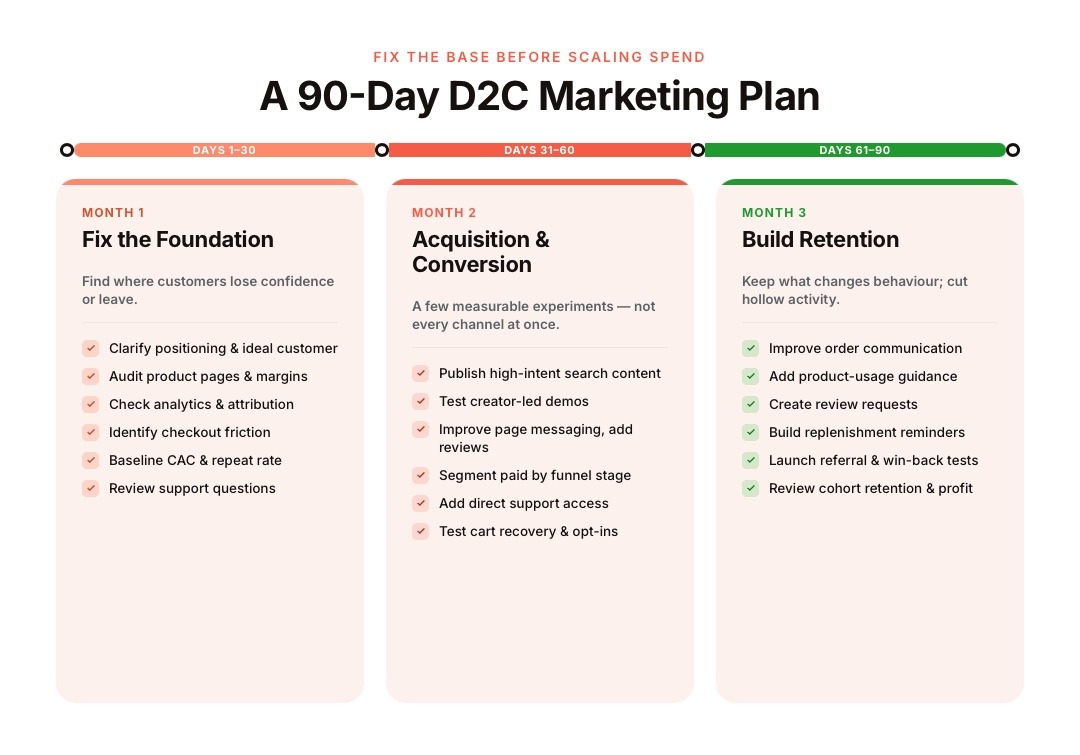
A 90-day plan gives teams enough time to improve the foundation, test campaigns, and add retention workflows.
Days 1–30: Fix the Foundation
During the first month:
- Clarify brand positioning
- Define the ideal customer
- Review top products and margins
- Audit product pages
- Check analytics and attribution
- Map the customer journey
- Identify checkout friction
- Measure current CAC and repeat purchases
- Review customer support questions
The goal is to understand where customers lose confidence or leave the journey.
Days 31–60: Improve Acquisition and Conversion
During the second month:
- Publish high-intent search content
- Test creator-led product demonstrations
- Improve product-page messaging
- Add customer reviews and FAQs
- Segment paid campaigns by funnel stage
- Create direct support access
- Test cart recovery
- Build first-party opt-in opportunities
Choose a small number of measurable experiments instead of launching every channel simultaneously.
Days 61–90: Build Retention
During the final month:
- Improve order communication
- Add product-usage guidance
- Create review requests
- Build replenishment reminders
- Launch a referral test
- Create a win-back segment
- Measure cohort retention
- Review channel profitability
Keep the workflows that improve customer behavior and remove activity that creates engagement without business value.
How Zoko Helps D2C Brands Build Customer Relationships
D2C brands often manage Shopify data, customer chats, broadcasts, cart reminders, COD confirmations, support, payments, and delivery updates through separate tools. These disconnected systems lead to delayed replies, broad campaigns, repetitive manual work, and incomplete customer journeys.
Zoko connects Shopify with the official WhatsApp Business API, bringing WhatsApp marketing, sales, support, and customer automation into one Shopify-synced platform.
With Zoko, Shopify merchants can:
- Send targeted broadcasts using customer and purchase data
- Sync Shopify products with WhatsApp Catalog
- Recover abandoned checkouts through automated WhatsApp reminders
- Confirm COD orders before dispatch
- Give customers a path from COD to prepaid payment
- Send order, shipping, and delivery updates automatically
- Build review and reorder journeys with FlowHippo Flows
- Answer common product and order questions with a WhatsApp AI chatbot
- Transfer complex conversations to sales or support agents
- Manage customer messages through a shared team inbox
- Connect Shiprocket with COD and delivery communication
- Add payment options to WhatsApp purchasing journeys
Zoko connects product discovery, purchase assistance, order communication, and repeat sales through one WhatsApp commerce system.
Common D2C Brand Marketing Mistakes
D2C growth becomes fragile when acquisition campaigns operate separately from the customer experience.
Depending Entirely on Paid Advertising
Paid advertisements provide reach, but the brand remains vulnerable when acquisition costs increase or platform performance changes.
Balance paid media with search content, direct communication, referrals, and retention.
Copying Competitor Positioning
Similar products do not require identical messaging. Copying competitors makes the brand harder to remember and pushes customers toward price comparisons.
Targeting Everyone
Broad targeting creates vague advertisements and weak product communication. Choose a clear customer, use case, and buying problem.
Discounting Every Campaign
Frequent discounts train customers to wait for offers and reduce pricing credibility.
Use education, product proof, access, convenience, bundles, and loyalty benefits alongside price incentives.
Sending the Same Message to Every Customer
A new visitor, a cart abandoner, a first-time buyer, and a loyal customer require different communication.
Segment messages according to customer behavior and purchase stage.
Ignoring Checkout Friction
Increasing traffic without fixing checkout creates more abandoned carts rather than more customers.
Neglecting Post-Purchase Communication
Poor delivery updates, confusing product usage, and slow support can prevent the second purchase.
Tracking Only ROAS
Platform ROAS does not reveal contribution margin, repeat purchases, cancellations, or customer lifetime value.
Automating Without Human Support
Automation should handle repetitive tasks while making it easier to escalate complex issues.
Collecting Customer Data Without Using It
Customer data creates value only when it improves segmentation, communication, product decisions, and customer experience.
Conclusion
D2C brand marketing in 2026 requires a connected growth system rather than a collection of isolated campaigns. The strongest brands combine clear positioning, creator-led discovery, useful search content, efficient acquisition, conversion-focused shopping experiences, and direct customer relationships.
Zoko helps Shopify D2C brands manage broadcasts, product discovery, cart recovery, COD confirmation, customer support, payments, AI automation, and retention through WhatsApp. Book a demo with Zoko or start a trial to connect your customer conversations with the complete Shopify buying journey.
Also read: How E-Commerce Digital Marketing Strategies Can Drive Customer Acquisition and Boost Sales
Also read: 20+ Proven Strategies to Increase Sales on Shopify: An Actionable Guide for Merchants
Frequently Asked Questions
What is D2C brand marketing?
D2C brand marketing is the process of attracting, converting, and retaining consumers through channels managed directly by the brand.
What are the best channels for D2C marketing?
Useful channels include SEO, social media, creator partnerships, paid advertising, email, WhatsApp, marketplaces, referrals, and physical retail.
How can D2C brands reduce customer acquisition costs?
Brands can improve positioning, organic search visibility, product-page conversion, creator content, referrals, cart recovery, and repeat purchases.
Why is customer retention important for D2C brands?
Retention increases the value generated by existing customers and reduces dependence on continuous spending to acquire new customers.
How can D2C brands use WhatsApp for marketing?
Brands can use WhatsApp for product recommendations, segmented broadcasts, cart recovery, COD confirmation, order updates, support, reviews, and reorders.
What metrics should a D2C brand track?
D2C brands should track CAC, contribution margin, MER, conversion rate, average order value, repeat purchase rate, customer lifetime value, return rate, and cohort retention.
What is the difference between D2C and B2C marketing?
D2C brands sell directly and own the customer relationship. B2C businesses may sell through retailers, distributors, marketplaces, direct channels, or a combination of these.
Does D2C mean a brand should avoid marketplaces?
No. D2C refers to a direct-to-consumer selling relationship, but a brand can still use marketplaces, quick commerce, retail stores, and other channels as part of an omnichannel strategy.
How often should D2C brands contact existing customers?
Message frequency should depend on customer consent, purchase behavior, product lifecycle, and message relevance. Brands should avoid sending campaigns simply to maintain a fixed schedule.
How long does a D2C marketing strategy take to produce results?
Paid campaigns may generate immediate traffic, while SEO, retention, referrals, and brand recognition usually build over a longer period. Use short testing cycles while measuring long-term customer value.
Interested to know more?
.svg)
Case Studies














Featured Posts


Continue reading

The E-Commerce Divide: How the Top 10% of Brands Use AI to Grow 5X Faster (And Why It’s Not for Everyone)
Drive Sales with WhatsApp Catalog Integration: Here's How