






WhatsApp Business API Without a GST Number: What You Actually Need in 2026

WhatsApp Business API Without a GST Number: What You Actually Need in 2026
A lot of small sellers assume the WhatsApp Business API is off-limits without a GST number. It's a fair assumption. Most guides mention GST early and make it sound mandatory. But GST is one accepted proof of business identity, not the only one.
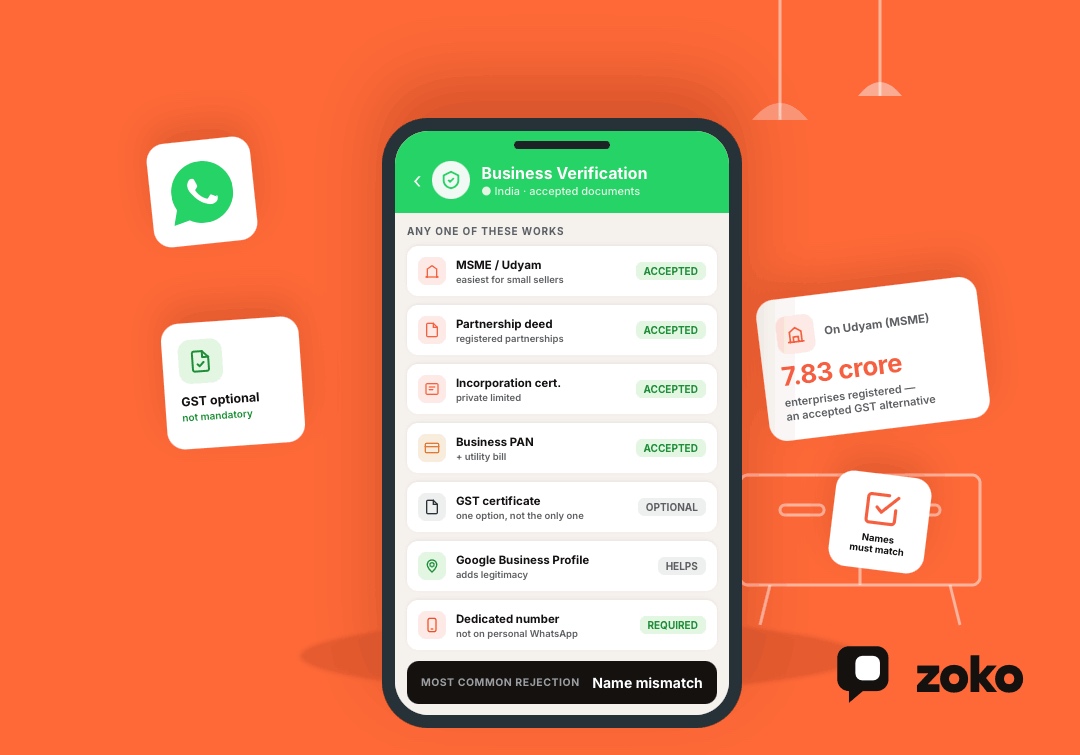
As of February 2026, over 7.83 crore enterprises are registered on India's Udyam platform, according to the Ministry of MSME's own press release — and Udyam/MSME registration is one of the accepted alternatives to GST for WhatsApp Business API verification, which means most small Indian sellers already hold a document that can stand in for it.
This article walks through what Meta actually requires, which documents can stand in for GST, and when GST genuinely becomes necessary as your business grows.
TL;DR
- GST is one accepted verification document for the WhatsApp Business API in India, not a strict universal requirement.
- Meta's own business verification accepts alternatives like MSME/Udyog Aadhaar registration, a partnership deed, or an incorporation certificate.
- Trial or early-stage access often works with lighter documentation, but going fully live typically needs stronger, GST-backed verification from most Indian BSPs.
- The single biggest cause of verification rejection is a mismatch between your legal name and address across documents, not the absence of GST specifically.
- As a business scales into regular WhatsApp commerce and marketing, GST registration usually becomes worth having anyway, for billing and compliance reasons separate from WhatsApp itself.
Do You Need a GST Number for WhatsApp Business API?
Short answer: not always. Meta's business verification process exists to confirm you're a real, legitimate business, not specifically to check whether you're GST-registered. GST happens to be a common proof of that in India, since so many businesses already have one. But it isn't the only proof Meta or most BSPs accept.
What Meta Actually Asks For
Meta wants a verifiable business identity attached to your Business Manager account, a dedicated phone number not already active on personal WhatsApp, and documents that confirm your business is who it says it is. In India, that typically means one of a handful of accepted documents: a GST certificate, a PAN card, an incorporation certificate, a partnership deed, or an MSME/Udyog Aadhaar registration. GST is on that list. It isn't the only thing on it.
Documents That Can Replace GST
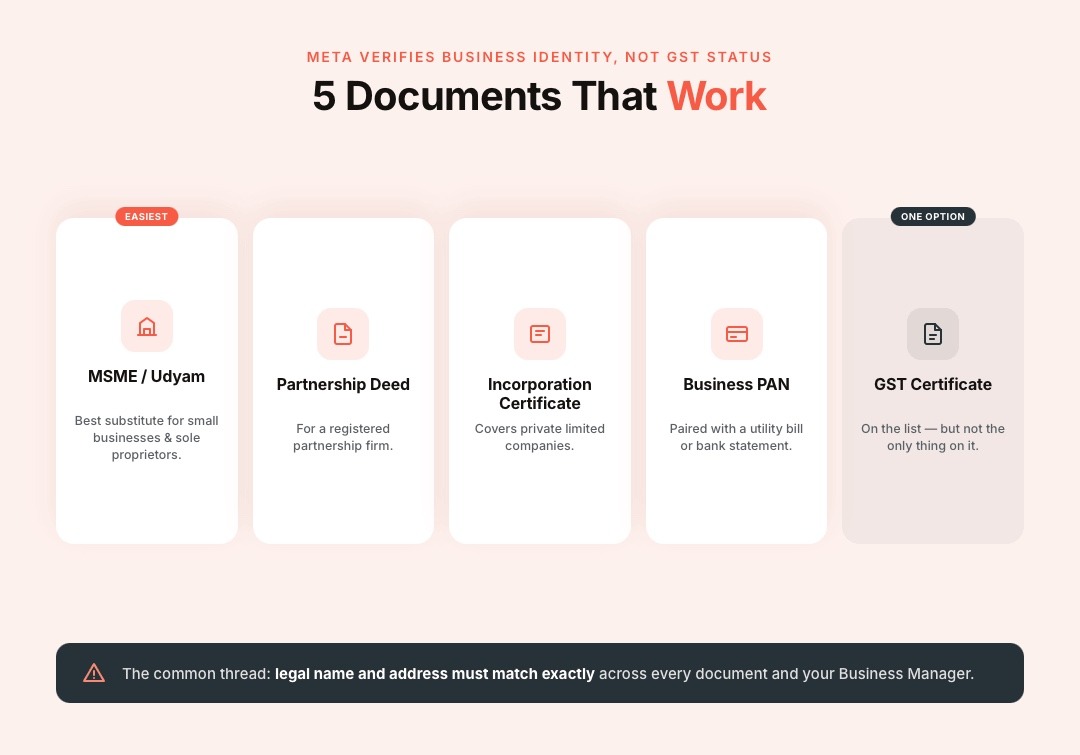
If you don't have a GST number, an MSME certificate is usually the easiest substitute for small businesses and sole proprietors. A partnership deed works if you're running a registered partnership.
A certificate of incorporation covers private limited companies. Even a business PAN paired with a utility bill or a bank statement in the business name can sometimes satisfy verification requirements, depending on the BSP you're onboarding through. The common thread across all of these is that the legal name and address need to match exactly across every document and your Business Manager account. That mismatch, more than the absence of any single document, is what usually gets an application rejected.
Where GST Actually Becomes Necessary
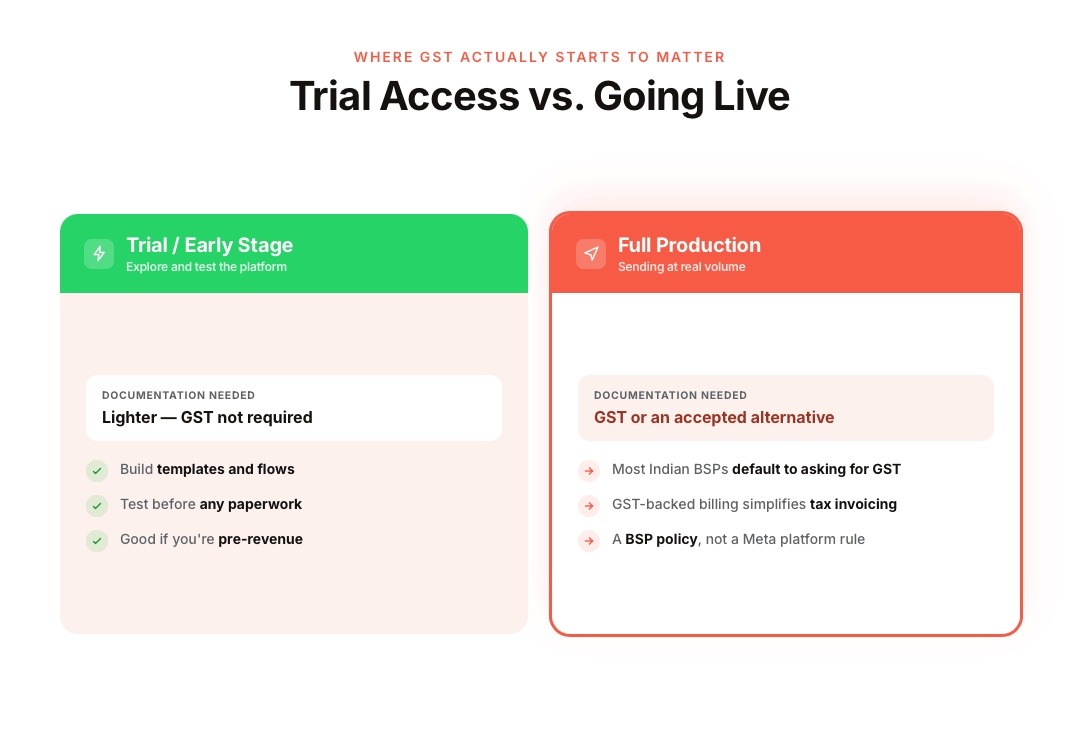
This is the part worth being honest about. While Meta itself doesn't hard-code GST as mandatory, most Indian BSPs default to asking for it once you move from a trial or sandbox setup into a fully live, production WhatsApp Business Account. That's partly a compliance habit in the Indian SaaS market, and partly because GST-backed billing makes tax invoicing simpler for both the BSP and the merchant.
Trial Access vs Going Live
Many providers let you explore the platform, build templates, and test flows on a free trial or limited tier using lighter documentation than what's needed for full production access. Once you want to send messages at real volume, though, most BSPs will ask for GST or one of its accepted alternatives before activating your account fully. If you're pre-revenue or still deciding whether WhatsApp is right for your business, this staged approach lets you test the platform before dealing with any documentation at all.
Also read: Documents Required for WhatsApp Business API: 2026 Shopify Checklist
How to Get Verified Without a GST Number
Start with whichever accepted document actually applies to your business structure — MSME certificate, partnership deed, or incorporation certificate. Double-check that the legal name and registered address on that document match your Meta Business Manager exactly, down to spelling and formatting. Set up a free Google Business Profile if you don't already have one; it's not a formal requirement, but it adds a layer of legitimacy that can smooth over an otherwise borderline verification. And keep a dedicated phone number ready that isn't currently active on personal WhatsApp or the WhatsApp Business App, since that's a hard requirement regardless of which documents you use.
The Catch to Plan For
Even with an accepted alternative to GST, a few things don't change. You still need that dedicated number, and you still can't reuse a number that's live on personal WhatsApp without deleting that account first.
If you ever apply for the green tick verification badge, having a stronger public presence — a live website, press mentions, an active Google Business Profile — helps your case, even though it isn't required for basic API access.
And if you're running any real transaction volume through Shopify or another ecommerce platform, most payment gateways and invoicing tools will eventually want GST anyway, separate from anything WhatsApp requires.
Who This Helps
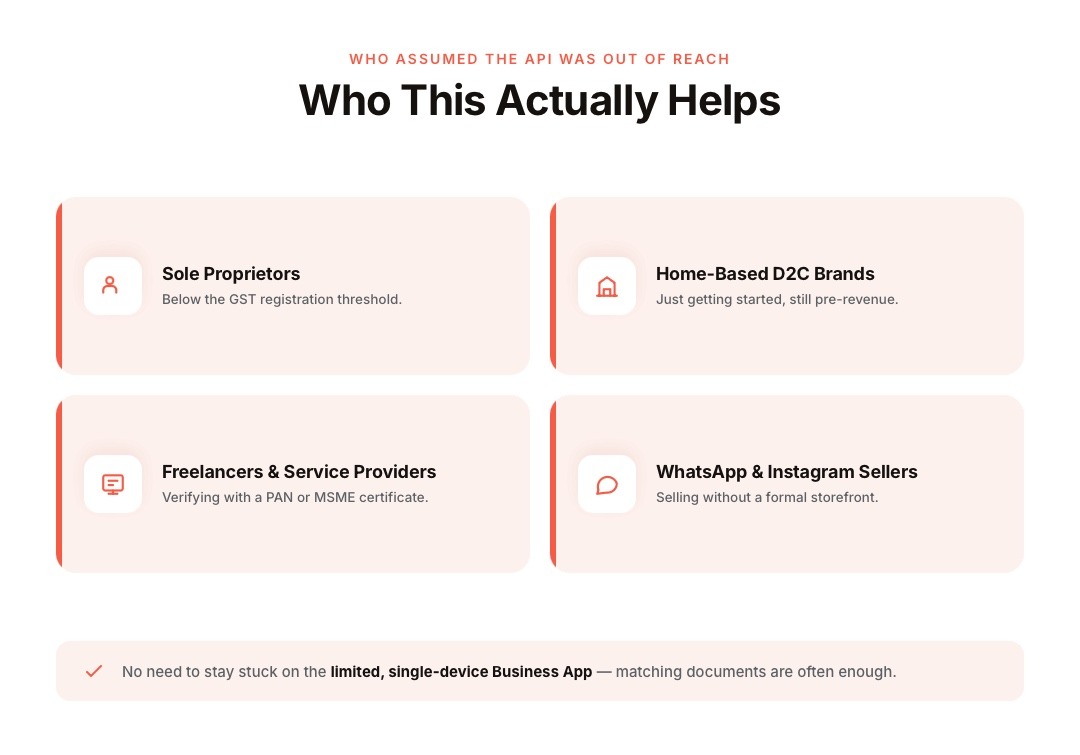
This mostly benefits small, early-stage sellers: sole proprietors below the GST registration threshold, home-based D2C brands just getting started, freelancers and service providers, and small retailers selling primarily through WhatsApp or Instagram rather than a formal storefront.
These businesses often assumed the API was out of reach without GST and stayed stuck on the limited, single-device WhatsApp Business App as a result. That's not necessary. An MSME certificate or a straightforward set of matching business documents is often enough to get started properly.
Choosing a Provider When You Don't Have GST
Not every BSP handles this the same way. Some insist on GST from day one, regardless of your business stage. Others offer a genuine trial tier that works with lighter documentation, letting you build and test before committing to full verification.
If you're an early-stage seller without GST yet, it's worth asking a provider directly what their minimum documentation requirement actually is, rather than assuming GST is non-negotiable everywhere.
Where Zoko Fits as You Scale
For Shopify sellers specifically, the calculus shifts once you're running real order volume. At that point, GST registration tends to become useful independent of WhatsApp, since Shopify payment processing and invoicing usually expect it anyway.
Once you're at that stage, Zoko's Shopify-native platform is built to take over the parts that actually drive revenue — catalog sync, abandoned cart recovery, and COD confirmation — through Zoko Flows, rather than treating WhatsApp as a bolt-on messaging tool.
You can see Zoko's pricing structure and estimate your own monthly cost before committing, browse how other merchants use the platform in Zoko's case studies, or get a broader sense of what it does on Zoko's homepage.
Frequently Asked Questions
1. Can a freelancer or individual seller get WhatsApp Business API without GST?
Yes, in most cases. Freelancers and individual sellers below the GST registration threshold can often verify using a PAN card, a Udyog Aadhaar/MSME certificate, or similar accepted documents instead, depending on the specific BSP's requirements.
2. Does Meta itself require GST for WhatsApp Business API verification?
No. Meta's verification process accepts a range of business documents, and GST is just one of them. The requirement to specifically provide GST usually comes from individual BSPs' own onboarding policies, not from Meta's underlying platform rules.
3. What happens if my business documents don't match my Meta Business Manager details?
Verification is likely to get rejected or delayed. Mismatched legal names or addresses across documents and your Business Manager account are the most common reasons applications fail, regardless of which specific document you submit.
4. Can I use my personal PAN instead of a business PAN for verification?
This depends on your business structure and the specific BSP. Sole proprietors sometimes qualify using a personal PAN paired with other business proof, but a business PAN or GST tends to be more reliably accepted across providers.
5. Will I lose my WhatsApp number if I apply without GST and get rejected?
No. A rejected verification attempt doesn't affect your existing number. You can typically resubmit with corrected or additional documents without losing access to the number itself.
6. Is it harder to get the green tick badge without GST?
The green tick depends on Meta's own eligibility criteria around business notability and authenticity, not specifically on GST. However, a stronger public business presence generally helps any verification case, GST or otherwise.
7. Do I need GST to accept payments through WhatsApp Catalog?
Not directly for WhatsApp Catalog itself, but the payment gateway or checkout flow you connect behind it may require GST depending on your transaction volume and the specific payment provider's own compliance rules.
8. Can I switch from a non-GST verification to GST-backed verification later?
Yes. As your business grows and you register for GST, you can update your verification documents with your BSP. This is a common path for small sellers who start lean and formalize later.
9. Are MSME and Udyog Aadhaar the same thing?
Udyog Aadhaar was the earlier registration system for micro, small, and medium enterprises in India; it has since been replaced by Udyam Registration, which serves the same MSME classification purpose and is commonly accepted as a GST alternative for verification.
10. Does not having GST limit how many messages I can send on WhatsApp API?
No. Message volume and template approval are governed by Meta's own policies and your BSP's plan, not by whether you have GST. GST affects verification and invoicing, not sending limits.
Interested to know more?
.svg)
Case Studies
















Featured Posts


Continue reading

The E-Commerce Divide: How the Top 10% of Brands Use AI to Grow 5X Faster (And Why It’s Not for Everyone)
Drive Sales with WhatsApp Catalog Integration: Here's How