






Conversational Commerce Definition: What It Actually Means in 2026

Conversational Commerce Definition: What It Actually Means in 2026
"Conversational commerce" gets thrown around a lot, often as a catch-all for anything involving a chatbot. That's not quite right, and the gap between the loose usage and the actual definition matters if you're deciding whether to invest in it for your store.
The term has also shifted meaningfully in the last couple of years.
What counted as conversational commerce in 2022, a scripted chatbot answering FAQs, looks basic next to what the same term describes in 2026.
This article defines the term precisely, explains what changed, and walks through where it actually shows up in ecommerce today.
TLDR
- Conversational commerce is the practice of using real-time, two-way messaging as a sales and support channel, not just a chatbot bolted onto a website.
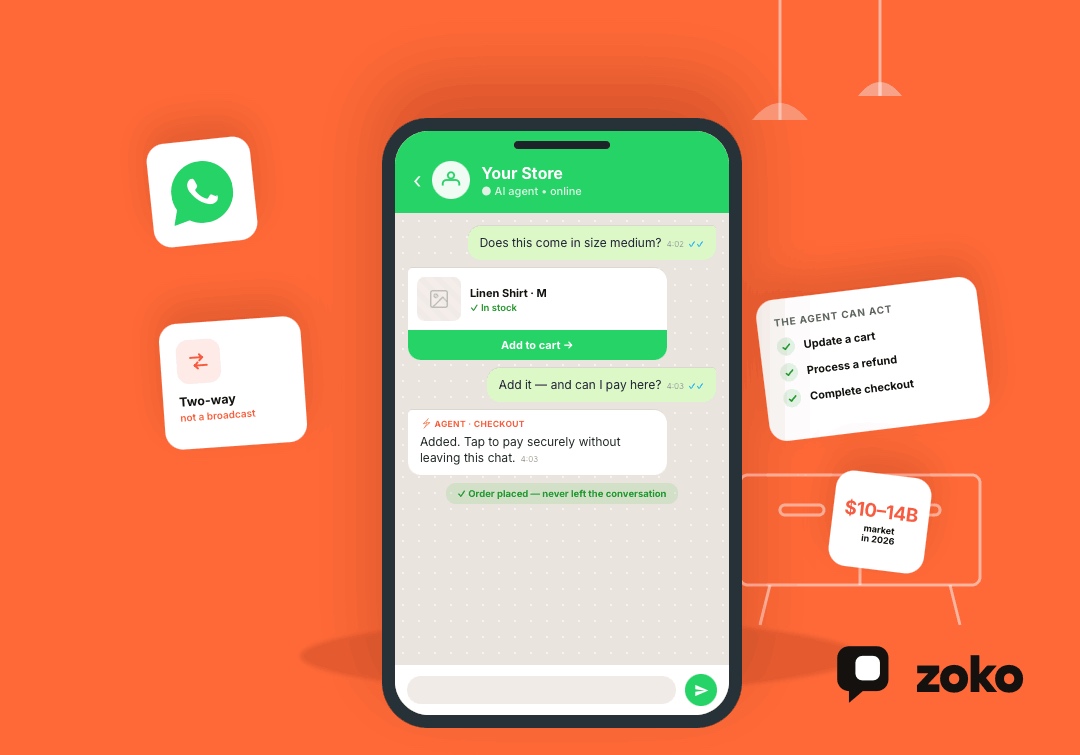
- The definition has shifted from bots that only answer questions to AI agents that can take action: process a refund, update a cart, or complete a checkout inside the chat itself.
- The global conversational commerce market is estimated at roughly $10-14 billion in 2026, depending on which research firm's methodology you use, with most projecting continued double-digit growth through the early 2030s.
- For ecommerce specifically, it shows up in product discovery, abandoned cart recovery, order support, and post-purchase engagement, most commonly through WhatsApp, Instagram, and web chat.
- Getting started well means picking one or two high-intent use cases first, not trying to automate every customer interaction through chat on day one.
What Is Conversational Commerce?
Conversational commerce is commerce that happens through dialogue. It's the practice of using real-time, two-way conversations — via messaging apps, live chat, or voice — as a primary channel to guide a customer from product discovery through purchase and after-sales support, all without the customer needing to leave the conversation, as described in IBM's own explainer on the topic.
The definition hinges on two things: it's conversational, meaning two-way and responsive rather than a one-directional broadcast, and it's commerce, meaning the interaction is meant to move a purchase forward, not just answer a support ticket. A brand sending a promotional blast isn't practising conversational commerce. A brand replying to "does this come in size medium?" with an in-stock answer and a direct link to buy, inside the same chat thread, is.
How Conversational Commerce Works
Conversational commerce runs on messaging channels a customer already uses daily, rather than a dedicated app or portal that the brand has to convince someone to install.
The Channels It Runs On
WhatsApp, Instagram DM, Facebook Messenger, SMS, and web chat widgets are the common channels. WhatsApp, in particular, has become a default channel for this in markets like India, Brazil, and much of Southeast Asia, where it's already the primary messaging app people use for everything, not just chatting with friends.
From Chatbots to AI Agents: What Changed
Early conversational commerce was mostly scripted chatbots answering a fixed set of FAQs, with a human taking over the moment a question fell outside the script. What's changed by 2026 is that AI agents can now take action inside the conversation itself, not just respond with information.
A modern conversational commerce setup can process a return, update an existing order, recommend a product from a full catalogue, and complete a purchase, all without handing the customer off to a human or a separate checkout page. That shift from answering to acting is what actually separates today's conversational commerce from the chatbot era it grew out of.
Conversational Commerce vs Traditional Ecommerce
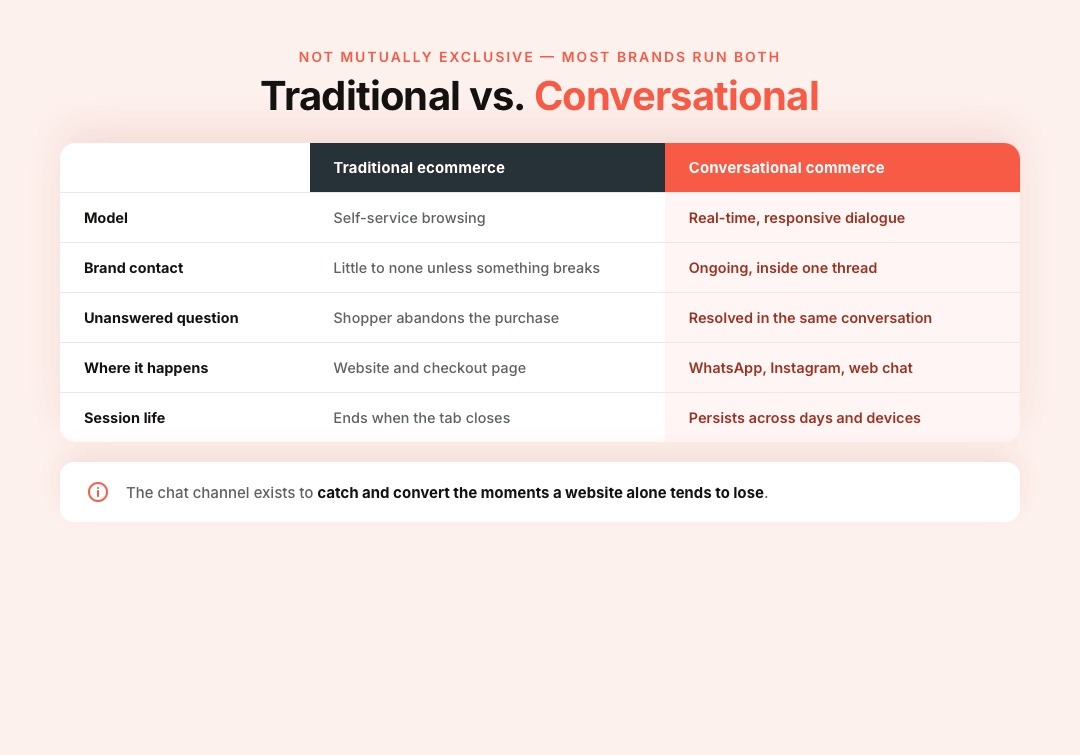
Traditional ecommerce is largely a self-service model: a customer browses a website, adds items to a cart, and checks out with little to no direct interaction with the brand unless something goes wrong.
Conversational commerce layers a real-time, responsive relationship on top of that. Instead of a customer abandoning a purchase because of an unanswered question about sizing or shipping, that question gets resolved in the same conversation as the purchase.
The two models aren't mutually exclusive — most brands running conversational commerce still have a full website behind it, and the chat channel exists to catch and convert the moments a website alone tends to lose.
Also read: WhatsApp Business API Ecommerce Features 2026: What You're Actually Buying
Why Conversational Commerce Is Growing in 2026
Estimates of the global conversational commerce market vary depending on what's being measured, but most sit in the $10 billion to $14 billion range for 2026, with continued double-digit annual growth projected into the next decade, according to Fortune Business Insights' market research.
The growth is being driven by two things at once: messaging apps have become the default communication channel for a large share of consumers globally, and AI has made it economically viable to automate the more complex, action-based interactions that once required a human agent.
Brands adopting it early are typically responding to a simple pattern: customers increasingly expect a fast, direct answer inside the channel they're already using, rather than being redirected to a separate support portal or ticketing form.
Conversational Commerce Examples for Ecommerce Brands
The clearest, most common use cases for ecommerce brands cluster around a few specific moments in the customer journey.
Product Discovery and Catalogue Browsing
A customer messaging to ask about a product can be shown a catalogue, images, and pricing directly inside the chat, rather than being sent a link back to the website. This keeps the entire discovery-to-purchase path inside one conversation instead of forcing a channel switch partway through.
Abandoned Cart Recovery
When a customer starts checkout and doesn't finish, a message in the same conversational channel, reminding them what's in their cart and addressing any lingering objections about shipping or returns, recovers a share of that lost revenue far more reliably than an email that often goes unread.
Order Support and Post-Purchase Engagement
Order status updates, delivery confirmations, and return requests handled conversationally reduce the back-and-forth of a traditional support ticket.
A customer asking "where's my order" gets an immediate, specific answer instead of a generic status page link.
How to Get Started with Conversational Commerce on Shopify
For a Shopify store, conversational commerce starts with picking a channel your customers already use, most often WhatsApp, and connecting it to your store's actual order and catalogue data rather than running it as a standalone chat tool. From there, start with one clear use case — cart recovery or order support tends to show the fastest, most measurable return — before expanding into product discovery or broader support automation. Trying to conversationalize every customer touchpoint on day one usually produces a worse experience than doing one thing well first.
Where Zoko Fits
Zoko is built specifically for Shopify brands running conversational commerce through WhatsApp.
WhatsApp Catalogue lets customers browse and buy directly inside the chat, and Zoko Flows automates abandoned cart recovery, order confirmation, and COD verification using real Shopify order data rather than a generic chatbot script.
Merchants can check Zoko's pricing and use the bill estimator to work out their own cost, or see how other Shopify brands are running conversational commerce in Zoko's case studies.
Frequently Asked Questions
1. Is conversational commerce the same thing as a chatbot?
No. A chatbot is one possible tool used within conversational commerce, but the term itself refers to the broader practice of using real-time, two-way conversation as a sales and support channel, which can involve human agents, AI agents, or a mix of both.
2. Which industries use conversational commerce the most?
Ecommerce and retail lead adoption, but travel, financial services, and healthcare booking are growing fast too. Any business where a customer has a question that could delay or derail a purchase tends to benefit from resolving it in conversation rather than on a static page.
3. Does conversational commerce require AI to work?
No. A human-staffed shared inbox handling WhatsApp or chat messages is still conversational commerce. AI simply makes it possible to automate a larger share of those conversations at scale without proportionally growing a support team.
4. How is conversational commerce different from live chat on a website?
Live chat is typically limited to the website session itself and ends when the tab closes. Conversational commerce, especially over WhatsApp or messaging apps, persists across sessions and devices, letting a customer pick up the same conversation days later.
5. Can small ecommerce stores realistically use conversational commerce?
Yes. Small stores often see faster returns than larger ones, since a single automated cart recovery or order-status flow can meaningfully reduce manual support work relative to their size, without needing a large team or budget to get started.
6. What's the difference between conversational commerce and social commerce?
Social commerce refers to buying directly within a social media platform's native shopping features. Conversational commerce is broader and channel-agnostic, covering any real-time messaging interaction, including but not limited to social platforms like Instagram.
7. Does conversational commerce work for B2B, not just B2C brands?
Yes, though the use cases differ. B2B conversational commerce more often centres on order reordering, account-specific pricing questions, and procurement support, rather than the discovery-and-impulse-purchase pattern more common in B2C.
8. How do I measure whether conversational commerce is working for my store?
Look at conversion rate from conversation to purchase, cart recovery rate, and reduction in support ticket volume, rather than just message volume or response time, since those don't directly indicate whether the channel is driving revenue.
9. Is conversational commerce more expensive to set up than a standard chatbot?
Not necessarily. Costs depend on the platform and channel volume rather than the concept itself. A basic WhatsApp-based cart recovery flow can cost far less to run than maintaining a large live-chat support team, even though it delivers a more capable customer experience.
10. Will conversational commerce replace traditional ecommerce websites?
Unlikely in the near term. Most brands run it alongside a full website rather than in place of one, using conversational channels to catch and convert specific moments — like an abandoned cart or a product question — that a static site alone tends to lose.
Interested to know more?
.svg)
Case Studies




















Featured Posts


Continue reading

The E-Commerce Divide: How the Top 10% of Brands Use AI to Grow 5X Faster (And Why It’s Not for Everyone)
Drive Sales with WhatsApp Catalog Integration: Here's How