





WhatsApp marketing already works for ecommerce. The real challenge for Shopify merchants is choosing the right platform to run their business. With more than 175 million people messaging businesses on WhatsApp every day, the channel has become a core part of how customers discover products, ask questions, and complete purchases.
That opportunity also means the market is crowded with WhatsApp marketing services. Some focus on broadcast campaigns. Others prioritize automation, customer support, or ecommerce integrations. Choosing the wrong platform can limit how well your campaigns scale, how quickly you respond to buyers, and how effectively you convert conversations into sales.
This guide breaks down what a WhatsApp marketing service actually includes, the features that matter for Shopify merchants, and the steps to choose a platform that turns WhatsApp into a reliable revenue channel.
Key Takeaways
- WhatsApp marketing is a high-impact channel for businesses. Its strong open rates and real-time messaging help brands engage customers more effectively than traditional channels.
- A structured setup is key to launching successfully. Shopify merchants should define goals, choose a reliable BSP, grow an opt-in list, and create approved message templates.
- Several industries benefit from WhatsApp marketing. Ecommerce, healthcare, financial services, travel, education, and real estate use it to improve communication and conversions.
- Proven strategies drive results for Shopify stores. Cart recovery messages, targeted broadcasts, in-chat product browsing, and post-purchase follow-ups increase conversions and repeat sales.
- Best practices keep campaigns effective and compliant. Messaging opted-in users, controlling frequency, responding quickly, and tracking performance sustain long-term results.
What are WhatsApp Marketing Services?
WhatsApp marketing is the strategic use of WhatsApp, primarily through the WhatsApp Business App or the WhatsApp Business API, to promote products, support customers, nurture leads, and drive sales through one-on-one conversations at scale.
Unlike traditional broadcast marketing, WhatsApp marketing services are permission-based and conversational. Customers opt in to receive your messages.
WhatsApp marketing activities include:
- Promotional broadcasts — flash sales, new product launches, seasonal campaigns
- Abandoned cart recovery messages
- Order confirmations and shipping updates
- Customer support via automated chatbots or live agents
- Product catalog sharing and in-chat checkout
- Re-engagement campaigns for lapsed customers
Why WhatsApp Marketing Services Matter in 2026?
WhatsApp marketing has quickly become one of the most effective ways for businesses to reach customers. Message open rates can reach up to 98%, while traditional email campaigns see 20–30% open rates. This explains why many brands are shifting more of their communication to messaging platforms.
- Faster Customer Responses: Customers expect quick replies. Automated workflows and chatbots can respond within seconds, reducing wait times and improving support.
- Higher Customer Engagement: WhatsApp allows businesses to use images, emojis, voice notes, and interactive buttons, creating conversations that feel natural rather than transactional.
- More Personal Communication: Messages appear in the same inbox customers use for friends and family. This creates a more direct and personal connection with brands.
- Cost-Effective Marketing: Compared with large email campaigns or paid acquisition channels, WhatsApp marketing can deliver strong engagement and conversions at a low operational cost.
- Built for Mobile Users: WhatsApp is a mobile-first platform, which aligns with how most customers browse, shop, and communicate today.
For businesses of any size, WhatsApp marketing provides a practical way to improve communication, increase engagement, and turn conversations into measurable revenue.
How to Start Your WhatsApp Marketing Service: Step by Step
Launching WhatsApp marketing is not only about sending messages. It requires the right setup, tools, and workflows to turn conversations into measurable revenue. The steps below show how Shopify merchants can set up the channel correctly and automate key customer journeys.
Step 1: Define Your Goals
Before you send a single message, decide what you want to achieve. Are you focused on recovering abandoned carts? Increasing repeat purchases? Reducing support tickets? Your goals will shape every decision, from what platform you use to how you structure your message templates.
Step 2: Choose a WhatsApp Business Solution Provider (BSP)
To access the WhatsApp Business API, you need to work with a Meta-approved BSP. Your BSP is more than a technical gateway; it is your platform for managing campaigns, automations, multi-agent support, and analytics. Look for a BSP that:
- Integrates natively with your eCommerce platform (especially Shopify)
- Offers a no-code or low-code flow builder for automation
- Provides catalog syncing so you can showcase products in-chat
- Supports multi-agent inboxes for customer support
Step 3: Build and Verify Your Business Profile
Your WhatsApp business profile is often the first touchpoint a customer sees. Fill it out completely, business name, category, description, website link, address, and operating hours. A verified, complete profile builds trust immediately.
Step 4: Grow Your Opt-In List
WhatsApp marketing is permission-based. You can only message customers who have explicitly opted in to hear from your business. This is actually a strength, not a limitation; your list is made up of genuinely interested customers. Grow your opt-in list through:
- Checkout opt-ins on your Shopify store
- Click-to-WhatsApp ads on Facebook and Instagram
- Website pop-ups and chat widgets
- QR codes on packaging, receipts, or in-store displays
- Post-purchase thank-you emails with a WhatsApp sign-up CTA
Step 5: Create and Get Your Message Templates Approved
For business-initiated messages (like broadcasts and notifications), WhatsApp requires pre-approved message templates. These templates are reviewed by Meta to ensure they are not spammy or misleading. Write templates that are clear, personalized, and include a specific call-to-action.
Step 6: Set Up Automation Flows
Automation is where WhatsApp marketing moves from "useful" to "transformative." Set up flows that trigger automatically based on customer behavior, a cart abandonment reminder 30 minutes after drop-off, an order confirmation the moment a purchase is complete, and a re-engagement message when a customer has not bought in 60 days.
Step 7: Measure, Optimize, and Scale
Track your key metrics: open rates, click-through rates, conversion rates, and customer response times. Use this data to refine your message timing, content, and segmentation. The brands that win on WhatsApp are the ones that treat it as an always-optimizing channel, not a set-and-forget one.
Also Read: Steps and Strategies for WhatsApp Marketing Success
Also read: How to Send Promotional WhatsApp Messages for Marketing in 2026
Which Industries Benefit Most from WhatsApp Marketing Services?
WhatsApp marketing delivers strong results across several industries because it combines instant messaging, automation, and conversational sales. While ecommerce brands led early adoption, many sectors now use WhatsApp to streamline communication, reduce support load, and improve conversions.
Here is how different industries benefit from the channel.
- eCommerce and Retail (Including Shopify Brands): This is the strongest use case. Brands use WhatsApp for abandoned cart recovery, personalized promotions, order confirmations, and delivery updates. The combination of high open rates, catalog browsing, and real-time support turns WhatsApp into a full-funnel sales channel.
- Healthcare: Healthcare providers send appointment reminders, medication alerts, lab results, and follow-up messages. Automated reminders reduce missed appointments while keeping communication simple and direct for patients.
- Financial Services and Banking: Banks and fintech companies use WhatsApp for transaction alerts, fraud notifications, application updates, and customer support. Secure messaging and verified business profiles help maintain trust in high-value financial interactions.
- Travel and Hospitality: Hotels, airlines, and travel agencies share booking confirmations, itinerary updates, and check-in reminders through WhatsApp. Quick responses and personalized messages improve the customer experience and increase upsell opportunities.
- Education and EdTech: Educational institutions use WhatsApp for class updates, reminders, fee notifications, and admissions support. Chatbots also help qualify leads and guide prospective students through the enrollment process.
- Food, Beverage, and Restaurants: Restaurants use WhatsApp for order confirmations, delivery tracking, menu sharing, and promotional offers. In-chat ordering and updates reduce call volume and make ordering more convenient.
- Real Estate: Real estate businesses use WhatsApp to share property listings, schedule site visits, and answer buyer queries. Rich media support allows agents to send floor plans, images, and documents directly within the conversation.
Key WhatsApp Marketing Strategies for Shopify Merchants
Once your WhatsApp marketing service is set up, the next step is using it strategically. Most Shopify brands focus on a few proven workflows that drive conversions, recover lost revenue, and strengthen customer relationships.
- Abandoned Cart Recovery: Send a timely WhatsApp reminder when a customer leaves items in their cart. Personalized messages with product details and a direct checkout link often recover more carts than email.
- Segmented Broadcast Campaigns: Use customer data to send targeted promotions to specific groups, such as loyal buyers or category-based customers. Segmented broadcasts generate stronger engagement than generic campaigns.
- In-Chat Product Catalog and Shopping: Sync your Shopify catalog with WhatsApp so customers can browse products, ask questions, and purchase directly in chat. This reduces friction and speeds up buying decisions.
- Post-Purchase Engagement: Send order updates, request reviews, and offer reorder discounts after a purchase. These follow-ups help build loyalty and increase repeat purchases.
Also Read: Best WhatsApp Marketing Services in India 2025
Best Practices to Keep Your WhatsApp Marketing Services Effective
WhatsApp takes the user experience seriously. Meta actively monitors message quality and can limit or restrict accounts that generate too many blocks or complaints. Follow these non-negotiable best practices to stay in good standing and maintain high deliverability:
- Only message opted-in customers, never buy lists or message contacts who have not given consent
- Keep message frequency reasonable, do not bombard customers multiple times a day
- Always provide a clear opt-out option in your messages
- Use rich media thoughtfully; images, videos, and buttons should add value, not clutter
- Respond promptly, customers on WhatsApp expect faster responses than email (65% expect a reply within 5 minutes)
- Test your templates before broad rollout, so that they read naturally and generate positive responses.
Ready to Turn WhatsApp Into Your #1 Revenue Channel? Meet Zoko
If you are a Shopify merchant who is serious about WhatsApp marketing, Zoko is purpose-built for you. As an official Meta Business Partner, Zoko gives you enterprise-grade WhatsApp capabilities with a Shopify-native experience, no complex API setup, and no developer dependencies.
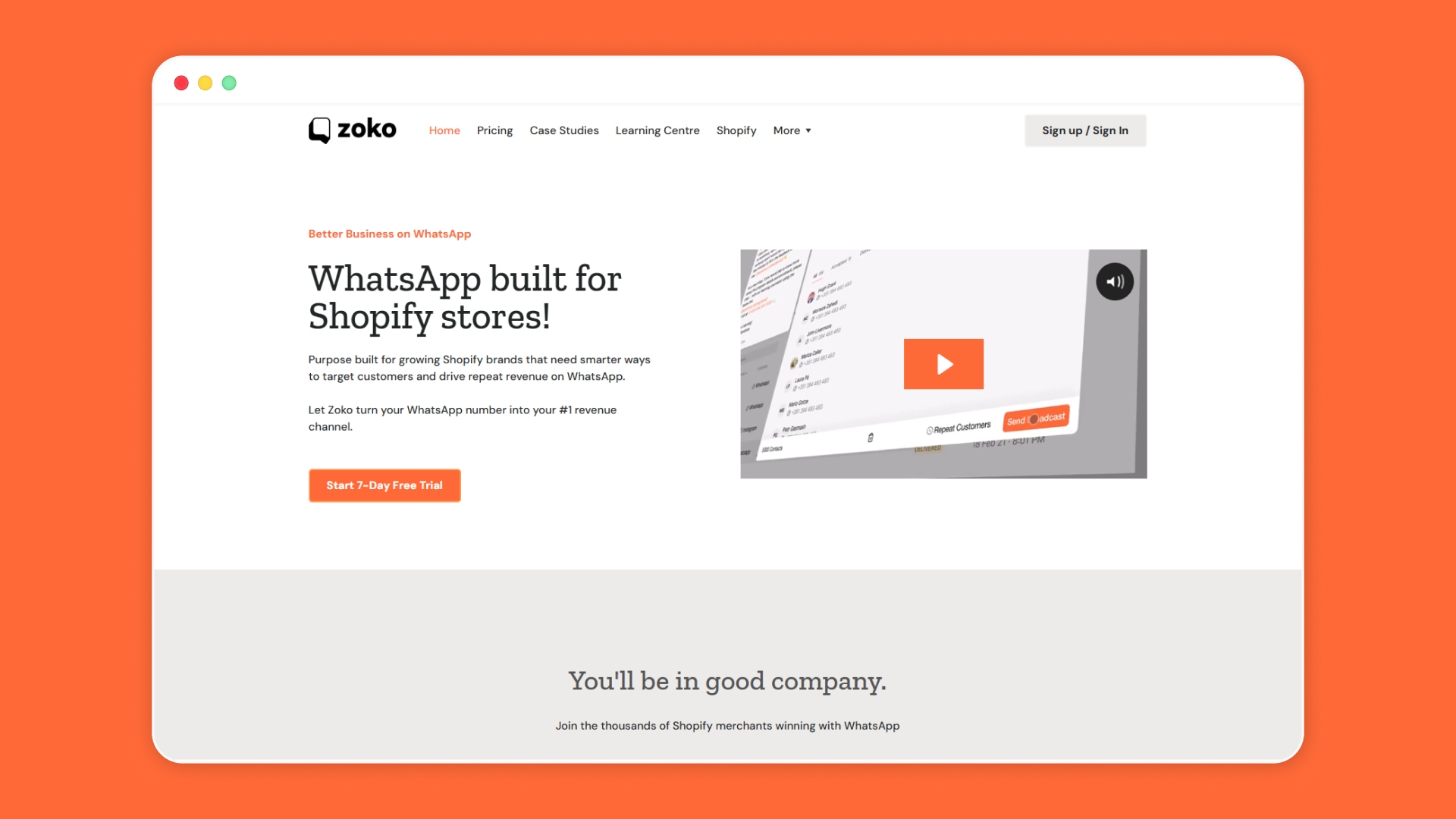
Here is a quick look at what Zoko brings to your WhatsApp marketing strategy:
- WhatsApp Broadcasts: Send personalized bulk messages with segmentation, achieving 5x better open rates than email
- Shopify Catalog Sync: Automatically sync your product catalog with WhatsApp and let customers shop directly in chat
- Advanced Flow Builder: Build multi-step automated workflows for cart recovery, order confirmations, COD confirmations, and more, without writing a single line of code
- Multi-Agent Shared Inbox: Let your entire support team manage WhatsApp conversations from one unified dashboard
- AI-Powered Customer Support: Automate responses to common queries, handle FAQs, and route complex issues to the right agent
- Shopify-Native Integrations: Deep integration with Shopify events, including real-time triggers for checkouts, orders, returns, and more
- WhatsApp CRM: Track customer conversations, purchase history, and engagement in one place
Join thousands of Shopify merchants already winning with Zoko. Start your 7-day free trial today!
FAQs
1. Is WhatsApp marketing worth it?
Yes, for many businesses, it delivers strong engagement because messages appear in a direct, frequently used communication channel. Brands often see higher open and response rates compared with traditional email marketing.
2. What is the 24-hour rule for WhatsApp Business?
The 24-hour rule means businesses can freely reply to a customer within 24 hours after the user sends a message. After that window closes, businesses must use approved message templates to start a new conversation.
3. What are the limitations of WhatsApp Business?
The standard WhatsApp Business app has limits such as restricted automation, fewer integrations, and difficulty managing large volumes of conversations. Businesses that need advanced campaigns or multi-agent support usually move to the WhatsApp Business API.
4. Is WhatsApp marketing safe?
Yes, when it follows platform policies and uses verified business accounts. WhatsApp uses end-to-end encryption and requires user opt-in, which helps protect customer privacy and reduce spam.
5. Is it better to use WhatsApp or WhatsApp Business?
For personal communication, the regular WhatsApp app is sufficient. Businesses benefit from WhatsApp Business because it provides features like business profiles, quick replies, product catalogs, and automation tools.
Interested to know more?
.svg)
Case Studies


















Featured Posts


Continue reading


The E-Commerce Divide: How the Top 10% of Brands Use AI to Grow 5X Faster (And Why It’s Not for Everyone)
Drive Sales with WhatsApp Catalog Integration: Here's How