



Most Shopify stores don’t lose customers because of pricing or product quality. They lose them in the gaps between steps: when shoppers pause, hesitate, or drop off before checkout. Globally, average e-commerce conversion rates remain around 2.5% to 3%, meaning only a small fraction of visitors complete a purchase, and many never reach the final stage of the buying process.
Mapping your Shopify customer journey helps you see those moments clearly. It shows how shoppers move from discovery to checkout, where hesitation creeps in, and what stops them from completing a purchase. When you understand that path, you can remove friction at the right points and unlock better engagement and growth.
Key Takeaways
The Shopify customer journey is the actual path a shopper takes from first contact to post-purchase. It includes every step, pause, question, and decision that happens before and after checkout.
This journey rarely moves in a straight line. A shopper may land on a product page, leave to compare options, return through a message link, ask a question, and only then decide to buy. Mapping the Shopify customer journey helps you see the actual sequence rather than assuming how customers should behave.
For Shopify merchants, the journey is shaped by:
Once the Shopify customer journey is clear, the next step is breaking it down into the key stages shoppers move through as they decide, buy, and return.
You can also support your Shopify customer journey through WhatsApp using Zoko, which connects product conversations, order updates, and customer support directly with your Shopify store. Book a demo to see how Zoko fits into your customer journey.
Most Shopify customer journeys can be understood through five clear stages. These stages reflect how shoppers move, pause, and decide across an online store. Not every shopper follows them in order, but each stage reveals different needs and risks.
Mapping these stages helps you focus on what matters at each stage, rather than treating every visitor the same way.
This is where shoppers first discover your store or product. At this stage, people are not ready to buy. They are scanning, comparing, and deciding if your store feels relevant and trustworthy.
Common actions include:
Common drop-off reasons:
Your goal here is clarity, not persuasion.
In the consideration stage, shoppers are interested but cautious. They start asking questions, checking details, and comparing options before committing.
Common actions include:
Common drop-off reasons:
This stage is where hesitation usually begins.
This is the moment of decision. Shoppers move to checkout and choose how they want to pay. Minor issues here can undo all earlier efforts.
Common actions include:
Common drop-off reasons:
The purchase stage needs speed, simplicity, and reassurance.
The journey does not end after checkout. Once an order is placed, shoppers want confirmation, updates, and easy access to support.
Common actions include:
Common drop-off reasons:
A smooth retention stage builds confidence for future purchases.
In this stage, satisfied customers become promoters. They share feedback, recommend your store, or return for repeat purchases.
Common actions include:
Common missed opportunities:
Advocacy grows naturally when earlier stages are handled well.
Also Read: The Power of Personalization: Elevate Your WhatsApp Marketing with Segmentation Strategies
Creating a customer journey map for your Shopify store is about more than just tracking clicks or sales. It’s about understanding how shoppers move from discovery to purchase, and where they need more clarity or reassurance along the way. Here’s how you can do it:
Before diving into data, start by identifying potential friction points. What aspects of the customer journey could be causing hesitation or drop-offs? For example, you might think that first-time buyers need clearer product details or that shoppers abandon their carts due to complicated shipping options. These initial insights will help focus your data collection and determine which metrics to prioritize.
Once you have your hypotheses in place, it’s time to gather both quantitative and qualitative data. Look at your Shopify reports and analytics to understand shopping behaviour: which products attract the most views, where shoppers are dropping off, and where they seem to hesitate.
Qualitative data also plays a role: customer support transcripts, feedback from WhatsApp chats, and even social media comments can reveal concerns, questions, or pain points that aren’t obvious in the numbers alone.
Next, use the data to create a customer persona. This is a representation of your ideal customer, based on the actual data you've gathered. For example, you might create a persona for a first-time buyer looking for a gift or a COD shopper who needs reassurance before placing an order. By understanding their goals, behaviours, and motivations, you can map out their journey more effectively.
Once you have a clear hypothesis, relevant data, and a defined customer persona, it’s time to bring everything together. This is where a customer journey map becomes useful.
Customer journey map templates help you organise how a shopper moves through your store and what they experience at each point. Instead of guessing, you map the journey from the customer’s point of view.
For a Shopify store, the journey usually follows five stages: awareness, consideration, purchase, post-purchase, and re-purchase.
For each stage, fill in the details of how your customer moves forward:
When these elements are laid out together, patterns become easier to spot, especially where shoppers hesitate or drop off.
The customer journey map is not static. Review and update it regularly to reflect changes in customer behaviour or new tools you introduce, like WhatsApp for order updates or customer support. Regular updates help you stay aligned with your customers’ evolving expectations.
This step-by-step process ensures you don’t just map the customer journey, but use it to actively improve your Shopify store and customer experience.
Also Read: Comprehensive Guide to WhatsApp AI Analytics Dashboard
Once you understand the stages, actions, and friction points, the next step is putting everything into a format you can actually use. A customer journey map works best when it is easy to review, update, and share across teams.
For most Shopify stores, a simple table is enough. It keeps the journey clear without turning it into a complex exercise. You can build this in a spreadsheet or a document and update it as shopper behaviour changes.
Below is a basic Shopify customer journey map template you can copy and adapt.
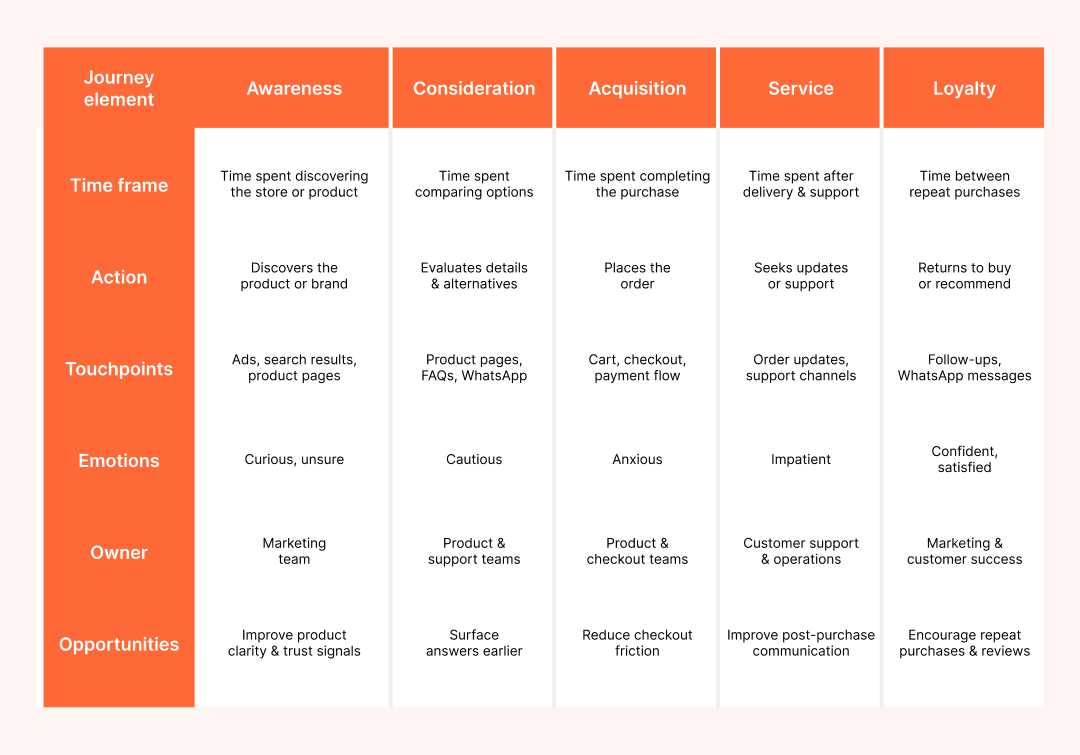
Once the customer journey is mapped clearly, the next step is understanding how those insights translate into real customer interactions across key touchpoints.
Also Read: How to Create a WhatsApp Broadcast List That Truly Works
Once the Shopify customer journey is mapped, the next step is acting on the points where shoppers pause or reach out. Zoko supports these moments by connecting Shopify data with WhatsApp conversations, keeping communication timely and relevant.
Zoko fits into the Shopify customer journey by supporting the moments where customers seek clarity, reassurance, or updates. It helps merchants use WhatsApp in a structured way without adding operational complexity.
The real value comes from acting on those insights. Clear product information, smoother checkouts, and timely communication reduce friction across the journey. Tools that connect Shopify data with customer conversations, like Zoko, make it easier to support shoppers at the moments that matter most.
Sign up for Zoko to manage Shopify customer conversations on WhatsApp.
A Shopify customer journey is the path a shopper follows from discovering your store to completing a purchase and interacting after delivery. It includes browsing, checkout, support, and post-purchase communication.
Mapping the Shopify customer journey helps you identify where shoppers hesitate, drop off, or seek clarity. This makes it easier to fix gaps that slow decisions or cause abandonment.
Most Shopify customer journeys can be mapped across five stages: awareness, consideration, purchase, retention, and advocacy. Not every shopper follows them in order, but each stage reveals different needs.
You can start with data you already have, such as Shopify reports, GA4 paths, top landing and exit pages, on-site search terms, and common support questions.
WhatsApp fits into the journey at key moments where shoppers ask questions, confirm orders, or track deliveries. Tools like Zoko help connect these conversations directly with Shopify data.



.svg)


