





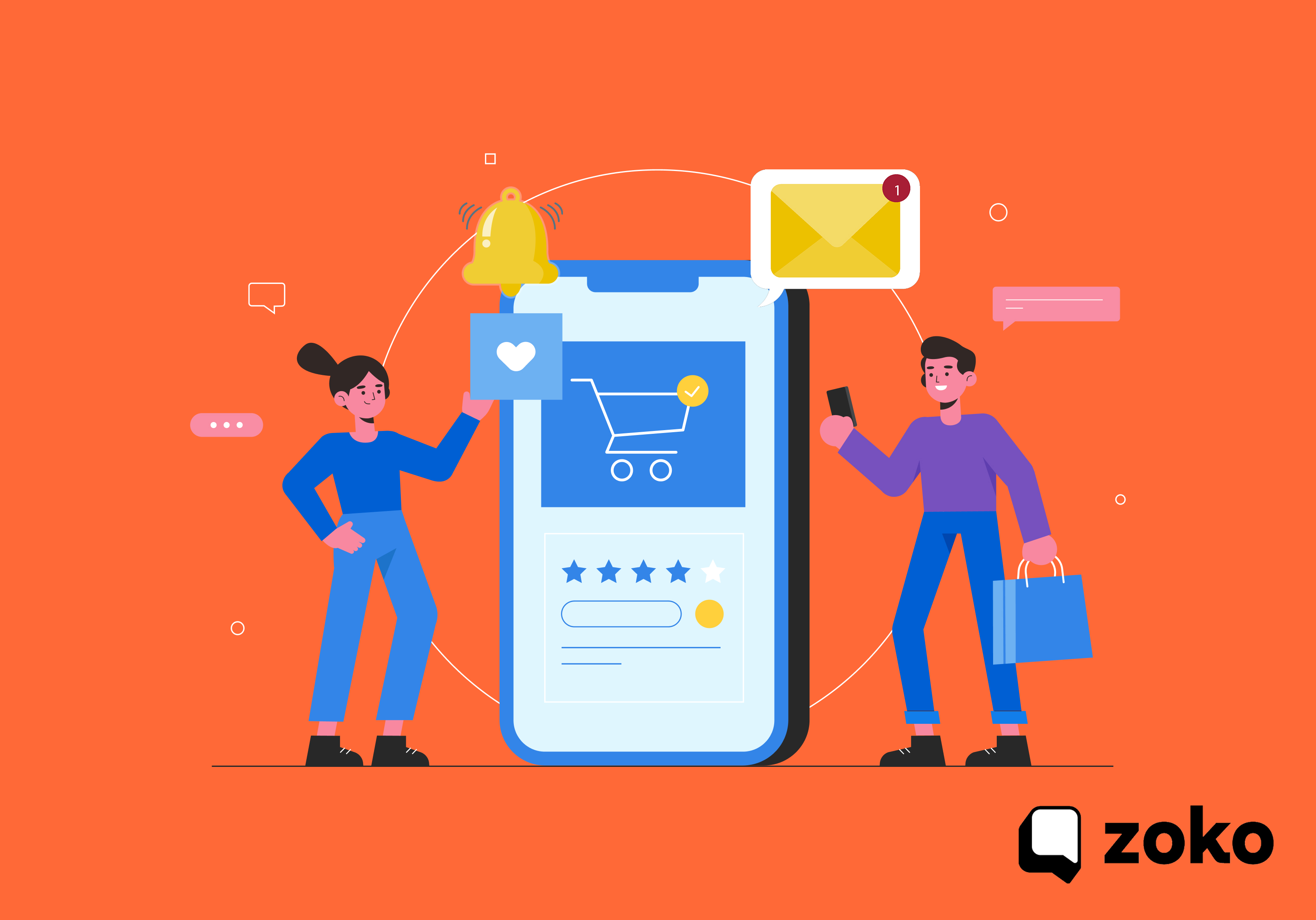

How WhatsApp Real-Time Shopping Notifications Drive Repeat Purchases

How WhatsApp Real-Time Shopping Notifications Drive Repeat Purchases
Every night, potential customers fill their carts but get distracted and leave, resulting in 70.19% of online shopping carts abandoned before checkout—a significant loss of revenue that frustrates sellers despite their best recovery efforts.
We understand how frustrating it can be to see so many potential sales slip away despite your best efforts to capture them. Traditional follow-up emails? They're getting buried in cluttered inboxes or arriving too late when the buying mood has passed.
WhatsApp real-time shopping notifications reach customers instantly on the platform they're already using, delivering timely, friendly reminders that customers check immediately, unlike traditional emails, often buried or arriving too late, thus turning abandoned carts into completed sales.
TL;DR
- Most customers abandon their carts, but WhatsApp real-time notifications recover sales by sending personal, timely messages that customers see and act on almost instantly, unlike emails that often get buried or ignored.'
- Adding a checkout link inside chat removes unnecessary steps and speeds up buying.
- Friendly, tailored messages keep customers coming back to shop again.
Why Do Customers Buy When You Contact Them Instantly?
When someone adds a product to their cart, it’s a signal that they’re interested right now. But that interest fades quickly. Most shoppers won’t return unless you reach out while they still remember what they wanted.
And here’s the reality: 82% of customers expect an instant reply from a brand. Wait too long, and you miss the moment that mattered most.
Here's what happens in those crucial first 10 minutes after someone shows interest:
- Minutes 1-3: Customer is still thinking about your product
- Minutes 4-7: They start browsing other options or get distracted
- Minutes 8-10: Your opportunity closes—they've moved on mentally
Every second of delay creates friction between want and purchase. Traditional communication methods miss this window entirely. Your carefully crafted email arrives three hours later when your customer is already comparing prices elsewhere.
WhatsApp real-time shopping notifications arrive while your customer is still in buying mode, creating instant revenue opportunities by meeting them where they are, increasing conversions as WhatsApp messages are checked immediately. Here’s how WhatsApp real-time shopping notifications actually work—and why they matter more than you think.
What Are WhatsApp Real-Time Shopping Notifications — and How They Work
WhatsApp real-time shopping notifications are automated messages triggered instantly by customer actions on your website, sending personalised alerts to engage them in real time. Here's exactly how it works:
When a shopper takes an action on your website, the system detects it immediately and triggers a personalised WhatsApp message to be sent instantly.
Let's say Sarah browses your online store and adds a ₹45 dress to her cart, then gets distracted by a phone call. Within seconds, your system detects this action and sends her a WhatsApp message: "Hi Sarah! That blue dress is still waiting for you. Complete your order now and get free delivery." She sees the notification immediately, clicks the link, and finishes her purchase—all because you reached her at the right moment.
This works through WhatsApp Business API, which connects your e-commerce platform directly to WhatsApp's messaging system. When customers interact with your store—browsing products, adding items to cart, or starting checkout—the API captures these actions and automatically sends targeted messages.
MERGE INTO: 'Meta's 24-hour session window allows sending free-form WhatsApp messages only within 24 hours after customer interaction; beyond that, messages must use pre-approved templates to comply with policies.
The Five Most Effective WhatsApp Shopping Notifications
1. Abandoned Cart Recovery. When customers leave items behind, instant reminders work wonders. Example: "Still thinking about those trainers? Complete your order in 2 clicks."
For detailed instructions, read our blog: Step-by-Step Guide to Recovering Abandoned Carts on WhatsApp
2. Back-in-Stock Alerts are Perfect for re-engaging customers who wanted something that was sold out. Example: "Good news! The jumper you wanted is available again."
3. Flash Sale Notification: Create urgency around limited-time offers based on browsing history. Example: "24-hour exclusive: 30% off everything you've browsed"
4. Loyalty Milestone Updates: Celebrate customer achievements and unlock new benefits. Example: "Congratulations! You've unlocked free shipping on future orders."
5. Order and Delivery Updates Keep customers informed throughout their purchase journey. Example: "Your order is out for delivery — track it here."
Instant replies build interest fast, but can they also build loyalty? Let’s look at how they do.
How Real-Time Notifications Create Loyal Customers
WhatsApp real-time shopping notifications leverage three psychological triggers—scarcity, urgency, and personal relevance—that motivate customers to make repeat purchases and build loyalty.
The Psychology Behind Repeat Purchases:
| Trigger | How It Works | Customer Response |
|---|
| Scarcity | Tells them stock is running low—creates urgency through limited availability. | Sparks fear of missing out and action. |
| Urgency | Adds a time limit to an offer—pushes fast decision-making. | Encourages instant purchases. |
| Personal Relevance | Tailors the message based on past actions or preferences. | Makes the offer feel made just for them. |
These behavioural triggers don’t just drive one-time conversions, they create a pattern of engagement that leads to loyalty. This is where the retention flywheel comes in.
What’s a Retention Flywheel?
Unlike traditional funnels that end after a purchase, a flywheel is circular. It keeps momentum going. In e-commerce, it’s the process of turning quick interactions into long-term customer habits. Every timely WhatsApp message adds to that momentum.
The Retention Flywheel:
- Notification arrives → Customer feels valued and remembered
- Action taken → Quick purchase creates a smooth, satisfying experience
- Reward received → Instant gratification builds emotional trust
- Loyalty deepened → Customer begins to expect and welcome future messages
You’ve seen what works, now here’s how to craft real-time notifications that actually get results.
How to Structure These Notifications for Maximum Impact
Your message is not just a simple alert; it is a tailored reminder designed to encourage action. The right structure turns a scroll into a sale. Done wrong, it's just noise.
The Essential Elements:
- Clarity:
Keep it under 120 characters with direct calls-to-action that require no second thought. WhatsApp is a chat app, not a newsletter. Your message should feel like a helpful friend, not a marketing department.
- Personalisation:
Include their name, a product they viewed or purchased, or their preferred category. This makes the message feel tailor-made.
- Timing:
Trigger messages based on customer behaviour—cart abandoners, recent browsers, or those inactive for 30+ days. Timed right, your message becomes a welcome nudge, not spam.
- Visual Appeal:
Use 1–2 emojis to add visual interest and draw attention to the main message or call to action. Think of them as helpful markers, not just decoration.
Proven Templates That Convert
- “Still eyeing this? It’s 10% off for 20 mins. Check out here →”
- “You bought this last month — need a refill?”
- “It’s back in stock: [product name]! Order now, ships today.”
- “We saved something special just for you—tap to unlock your personalised offer.”
- “Spotted you browsing. Want 15% off what you liked? It’s waiting in your cart.”
- “[First name], your early access to our newest collection ends in 3 hours. Tap to shop.”
Also read: WhatsApp Shopify Re-engagement for Dormant Customers: A Practical Guide
Setting Up WhatsApp Real-Time Notifications in Shopify (Step-by-Step)
To send automated messages like back-in-stock alerts or abandoned cart nudges for your Shopify store, you need WhatsApp Business API, which is designed for scale and allows automation, personalisation, and real-time messaging to thousands of customers beyond manual replies.
Before You Start: What You’ll Need
To use automated, scalable WhatsApp real-time shopping notifications, you need WhatsApp Business API access, a Shopify store, an integration tool, and customer opt-in; the regular WhatsApp app cannot support these features.
Now that you're clear on the “why,” here’s exactly how to set it up, without needing a tech team.
Step 1: Get WhatsApp Business API Access
Before anything else, you’ll need access to the official WhatsApp Business API. This isn’t the same as using the app—it’s for automated messaging at scale. Apply through a provider, verify your business, and enable opt-ins for compliance.
- Ensure your display name and business info are approved by Meta
- Set up double opt-ins during checkout or sign-up to ensure customers explicitly consent to receive WhatsApp notifications, complying with privacy and messaging policies.
- Keep messages transactional or relevant—avoid hard-sell spam
Step 2: Sync Your Shopify Product Feed
You’ll need your product data, images, pricing, SKUs, connected to WhatsApp. This allows notifications to show live info pulled straight from Shopify.
- Use a WhatsApp integration tool that supports syncing your Shopify product feed, including titles, images, pricing, and inventory, to ensure live, accurate information in notifications.
- Ensure product titles, images, and inventory are kept up-to-date
- Test a few products to check formatting inside WhatsApp messages
Step 3: Map Customer Events That Trigger Messages
Think about moments that matter—when a customer shows intent but doesn't convert, or when an update adds value.
- Add to Cart → send reminder within 1–2 hours
- Order Delivered → send reorder nudge after 15–20 days
- Item Back in Stock → message those who browsed or wishlisted it
These aren’t random pings, they’re timed, relevant nudges that feel helpful, not spammy.
Step 4: Build Notification Flows Without Coding
Use a no-code visual flow builder to design automated notification sequences that respond to customer behaviours and optimise timing for engagement.
- Set delays between messages to avoid feeling intrusive
- Personalise using customer name, product, or previous actions
- Start with one flow—like cart recovery—then add upsell or reorder flows later
- Tip: Build flows around specific customer goals. Not all messages need a discount—some just need good timing.
Step 5: Test, Optimise, and Launch
Don’t go live without testing. A/B test different copies, timings, and formats to see what sticks.
- Test short vs. detailed messages
- Try emoji-led vs. clean CTA styles
- Track click-throughs, replies, and conversions—not just sends
After launching your WhatsApp real-time shopping notifications, tools like Zoko integrate with Shopify to automate timely and personalised notifications, such as cart recovery and back-in-stock alerts, all without coding.
Let’s look at how real brands are using WhatsApp to turn conversations into repeat sales.
Real Results: How Brands Are Driving Repeat Revenue With WhatsApp
Zoko is an all-in-one WhatsApp solution built for Shopify brands. From multi-agent inboxes to catalogue-linked shopping flows, it helps teams handle volume while keeping things personal.
Let’s look at how two fast-growing brands are using it to drive real revenue:
- Purplle: Managing 40K+ Customers Seamlessly on WhatsApp
Beauty brand Purplle scaled its support operations using Zoko’s Unified Multi-Agent Inbox, allowing over 100 agents to manage 40,000+ customer conversations every month—through a single WhatsApp number.
Zoko enabled chat reassignment, private internal notes, and quick replies—boosting agent efficiency while keeping the customer experience smooth and uninterrupted. Setup took less than a day, and the results were immediate: higher satisfaction scores and faster resolution at scale, all powered by WhatsApp real-time shopping notifications.
- Zillionaire: 30K WhatsApp Numbers Captured for High-Intent Retargeting
Jewellery brand Zillionaire used Zoko’s WhatsApp pop-up campaigns to build a remarketing list of 30,000 high-intent customers.
By replacing email pop-ups with WhatsApp opt-ins, they engaged casual browsers and abandoned visitors with personalized, real-time shopping notifications. This led to a 3.63% conversion rate and a strong, verified remarketing base that now fuels their WhatsApp-first sales strategy.
Measuring the Impact of Your Notifications
To measure the effectiveness of your WhatsApp real-time shopping notifications, track key metrics such as delivery rate, open rate, response rate, CTR, conversion rate, repeat purchase interval, opt-out rate, and customer satisfaction score, using tools you likely already have.
1. Delivery Rate
- What it is: The percentage of messages successfully delivered out of those sent.
- Why it matters: If your messages aren’t getting delivered, nothing else matters.
- How to measure: Check your WhatsApp Business dashboard—delivery stats are tracked automatically.
2. Open Rate
- What it is: The percentage of people who opened your message.
- Why it matters: It shows how many recipients actually saw it.
- How to measure: WhatsApp dashboards show delivered vs. opened figures.
3. Response Rate
- What it is: The number of users who replied after receiving your message.
- Why it matters: A strong response rate means your messages are relevant and engaging.
- How to measure: Most CRM tools integrated with WhatsApp show reply counts per campaign.
4. Click-Through Rate (CTR)
- What it is: The percentage of users who clicked the link or button in your message.
- Why it matters: A high CTR means your content and call-to-action are working.
- To measure engagement, add simple tracking links to your messages and check how many users click. You can use basic URL shorteners with tracking features.
5. Conversion Rate
- What it is: The percentage of users who purchased after clicking.
- Why it matters: This tells you whether your messages are actually driving sales.
- How to measure: Check your store’s order data to see how many users completed purchases after receiving your messages.
6. Repeat Purchase Interval
- What it is: The average time between two purchases from the same customer.
- Why it matters: Shorter intervals indicate higher loyalty and repeat buying.
- How to measure: Look at the customer order history and calculate the time between orders.
7. Opt-Out Rate
- What it is: The percentage of people who unsubscribed from receiving messages.
- Why it matters: A high opt-out rate means your messages might be too frequent or irrelevant.
- How to measure: Track how many users click the "Stop" or "Unsubscribe" option in your messages.
8. Customer Satisfaction Score (CSAT)
- What it is: A quick rating customers give after an interaction or purchase (usually on a 1–5 scale).
- Why it matters: It reflects how happy your customers are with your service.
- How to measure: Send a short message after delivery asking, “How was your experience?” and provide options like 1–5 stars or thumbs up/down.
Stay Compliant: WhatsApp Notification Rules and Consent Best Practices
If you're sending messages on WhatsApp, you need to follow a few important rules to avoid getting blocked or reported.
Here’s the golden rule: Meta’s 24-hour rule allows you to send free-form messages only within 24 hours of a customer’s reply. After that, you’ll need to use pre-approved templates to stay compliant. To stay safe, always ask for consent early. You can do this during:
- Checkout: “Get order updates on WhatsApp”
- Sign-up: “Get early access to offers on WhatsApp”
- First chat: “Would you like to hear from us again?”
Once a customer opts in, you can send useful updates such as order alerts, restock notices, or discount offers, ensuring messages feel helpful rather than pushy.
To stay fully compliant while getting results, it helps to use a tool built for it. Zoko is an official Meta Business Partner, trusted to follow WhatsApp’s rules and help brands send approved, value-first messages. No guesswork—just smooth, policy-safe messaging.
Also read: How to Use Meta Chat for Conversations and Support
End Note
Real-time conversations can turn a one-time visitor into a loyal one. WhatsApp real-time shopping notifications put your brand right where your customers are, exactly when it matters. It’s not about blasting offers. It’s about showing up with relevance and timing.
Achieving repeat customers requires delivering the right product at the right time through the right channel; Shopify brands can close more sales and build retention more efficiently by leveraging timely WhatsApp notifications.
Zoko is built for brands like yours. From cart recovery to post-purchase engagement, Zoko helps you automate WhatsApp real-time shopping notifications that feel personal, not robotic. Everything runs behind the scenes—so you can focus on growth.
Start your free trial now. Let your WhatsApp number do more than support. Let it sell.
Must read: How to Set Up a WhatsApp Business Channel
Interested to know more?
.svg)
Case Studies



















Featured Posts


Continue reading

The E-Commerce Divide: How the Top 10% of Brands Use AI to Grow 5X Faster (And Why It’s Not for Everyone)
Drive Sales with WhatsApp Catalog Integration: Here's How